Progressive upsets in Colorado’s Democratic primary could spell change for short-term rental oversight as many see higher rates and lower occupancy
Occupancy for short-term ski rentals is pacing slightly behind 2025 as daily rates continue to climb


Austin Colbert/The Aspen Times
Short-term rentals in Colorado ski towns are seeing higher rates, lower occupancy and unsteady revenue heading into the fall season. Rental experts say the market’s future could be shaped by the results of the state’s Democratic primary election.
The Colorado Short-Term Rental Alliance, a nonprofit volunteer and advocacy organization known as COSTRA, hosted a state-of-the-industry webinar on July 23, bringing together vacation rental owners and experts to talk about the past — and potential future — of the short-term rental market.
COSTRA, which evolved from the Colorado Lodging and Resort Association in 2025, calls itself a unified voice for short-term rental hosts across the state, with existing chapters in Denver and Summit County. The organization’s mission relies on supporting policies that protect the rights of property owners and managers, ensuring the long-term sustainability of Colorado’s short-term rental industry.
Data shared by Daniel Leifeld, director of business development with Key Data and a town council member in New Castle, illustrates a clear divide forming between ski and non-ski markets, especially in the areas of rates, revenue and occupancy. Non-ski markets currently lead in occupancy, while resort communities are currently lagging behind last year’s pace. Ski markets have also maintained nearly double the average daily rate of non-ski markets, with pricing expected to go up.
Colorado’s short-term rental market in ski resort communities finished 2025 with a 25% paid occupancy rate, in line with 2024. In other words, out of 100 available rental nights, only a quarter of them were booked and paid for by guests.
“Because of the lack of snow this spring — I don’t think I’m breaking any news here — we were down quite a bit from an occupancy perspective in the first half of the year,” Leifeld said.
In 2026, the short-term rental market is pacing slightly behind 2025, sitting at 18% compared to the 19% pace recorded this time last year. The largest gaps in pacing are in late summer and fall. Winter demand also remains limited, which Leifeld said is likely because visitors are waiting to see what the snowfall will look like this year before committing to a trip.
While the low snow year’s limited impact on booking pace for 2026 could be encouraging for rental owners, Leifeld said this year’s spike in average daily rates for ski rentals is cause for concern.
Average daily rates for short-term rentals across Colorado’s ski markets increased to $424 in 2025, up from $419 in 2024. Pacing for 2026 has already surpassed that, sitting at $454 compared to last summer’s $441 pacing.
“We’re kind of ignoring the very obvious fact that there’s low occupancy and pushing the rate somewhat to cover that lost occupancy, but it’s not working. We’re not making more money because of that,” Leifeld said. “Let’s not be quite so aggressive raising rates when occupancy or demand is this low. That is a surefire way to make sure you’re not going to make money.”
As higher rates are offset by lower demand, short-term rentals are seeing lower revenue overall. Leifeld said the market is pacing roughly $4 behind where it was last summer in terms of revenue per available rental night, though winter bookings are expected to build closer to arrival. Meanwhile, length of stay has remained relatively stable throughout the year, with longer stays recorded for late fall and early winter as travelers begin booking their ski vacations.
Most of that revenue — roughly 43% — is coming from visitors who book 60 to 180 days in advance.
“That’s partly because larger homes get booked further out, nicer homes get booked further out, but it’s also because there’s consistent demand for [those] properties in Colorado,” Leifeld said.
For ski rentals, direct bookings account for the largest share of guest check-ins, around 43%, followed by Airbnb at 33%. Direct bookings also generate the highest average daily rates and booking windows, bringing in more revenue than other channels.
Denver residents remain the largest customer for short-term rentals in Colorado, making up roughly 3.2% of renters — or 4% when combined with visitors from Colorado Springs — followed by Dallas and Houston, at 2.5% and 2.3%, respectively.
Unexpected primary wins could mean change for the rental market
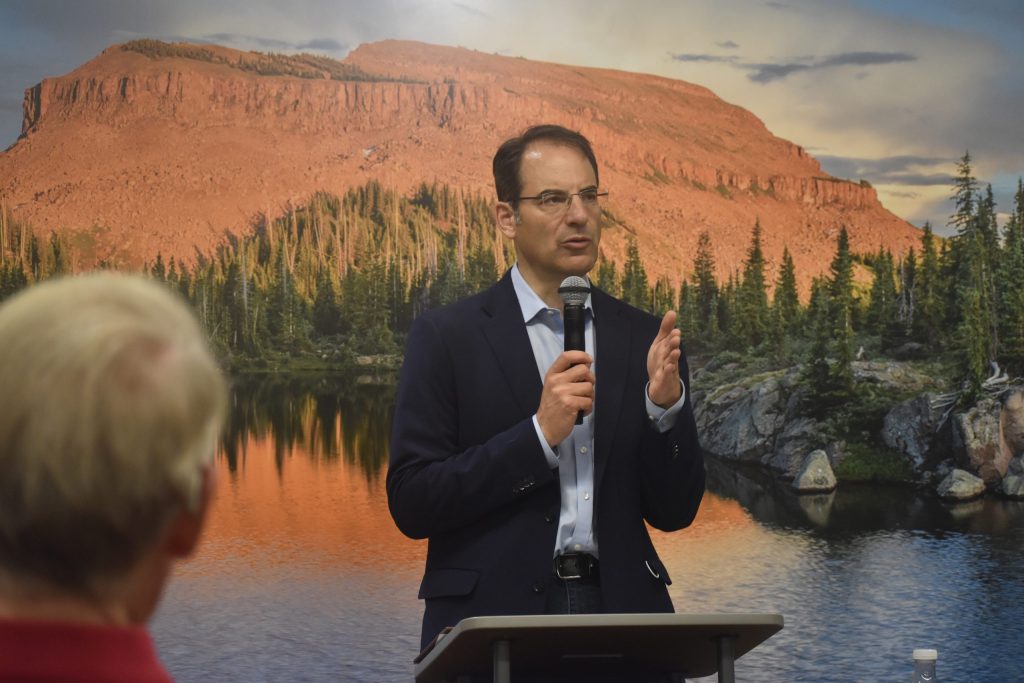
Looking ahead to 2027, COSTRA Executive Director Julia Koster noted the environment for short-term rentals might look a little different — thanks in part to some of the unexpected wins by more left-leaning candidates over establishment Democrats during the June primary.
“It’ll be really interesting to see the changes that happen at the Capitol. As we get ready for next year, it’s going to be quite a changing landscape,” Koster said.
One of the more prevalent housing challenges for ski areas is the oversight of short-term rentals and second homes. As many as one-in-three properties are used as a short-term rental in some ski towns, and around 50% of homes can sit vacant throughout the year, according to local housing studies and U.S. Census data.
With housing shortages and historically-high rental rates in some rural resort areas, Democratic candidates are once again eyeing short-term rental regulations as they approach the November general election.
“To be very honest, I’m not sure anyone could have predicted 100% of those primary results that came out of the election last month,” said Jaclyn Terwey, regional manager of government relations for Expedia Group. “Some of the polling this year had those races going in wildly different directions than how they ended.”
Colorado Attorney General Phil Weiser, winner of the Democratic gubernatorial race against U.S. Sen. Michael Bennet, has been “historically a little bit more into the weeds” on some of the issues that COSTRA cares about, Terwey said.
The gubernatorial candidate has placed affordable housing at the forefront of his campaign, promising to take executive actions aimed at bolstering and streamlining the state’s housing strategies on “day one,” if elected in November.
Weiser has supported broad rental regulations and consumer protections in the past, including cracking down on deceptive junk fees and anti-competitive algorithmic price-fixing by corporate landlords. Most recently, his gubernatorial agenda calls for tighter oversight of corporate landlords, consumer protection for tenants and active market regulations
Although Democrats have historically focused on tenant protections over legislative and financial support for established property owners, Terwey said Weiser’s recent nomination of Jefferson County Commissioner Lesley Dahlkemper for lieutenant governor is good news for short-term rental owners, identifying Dahlkemper as a “moderate individual.”
Dahlkemper is also a Jefferson County commissioner, which Terwey said has made favorable decisions for the short-term rental market.
“I think that is going to be helpful in the gubernatorial seat should the Democrats win,” she said. “Victor Marx is a little bit of a wild card. We’re not really sure what that’s going to look like if he does win, but I will say that that’s fairly unlikely given the voter makeup of the state of Colorado.”
Another noteworthy primary race for short-term rental owners was the Democratic race for attorney general, which was secured by Secretary of State Jena Griswold.
“That is going to be an interesting one to watch as well,” Terwey said. “She is also the slightly more left-leaning individual in that race out of the four candidates that went for it. … (that’s) not a problem in a lot of areas, (but) when we’re looking at tax issues and consumer issues, sometimes that can be a little bit more difficult with some of the more left-leaning politicians.”
For Summit County, which represents nearly 40% of all short-term rentals in Colorado, Consuelo Redhorse’s win in the House District 13 Democratic primary could mean stricter oversight on short-term rentals — which Redhorse listed as a legislative priority on her campaign website.
If Redhorse is elected in November, she will take over Colorado House Speaker Julie McCluskie’s seat, who is term-limited.
“House District 13 is very, very important for us,” Koster said, “Redhorse is definitely somebody that we want to talk to and build relationships with.”
For now, Terwey suggested that short-term rental owners keep an eye on bills and policies that deal with potential losses of federal funding, excise taxes, property taxes and empty homes taxes.
“Those are important things to remind your elected leaders, that there’s a ton of tax revenue that does come from vacation rentals,” Leifeld said. “I know that’s a touchy subject, but at the end of the day, vacation rentals are feeding into the economy from a budgetary standpoint.”

Support Local Journalism
Support Local Journalism
The Sky-Hi News strives to deliver powerful stories that spark emotion and focus on the place we live.
Over the past year, contributions from readers like you helped to fund some of our most important reporting, including coverage of the East Troublesome Fire.
If you value local journalism, consider making a contribution to our newsroom in support of the work we do.