Study finds manmade whitewater parks in Colorado may inhibit fish migration
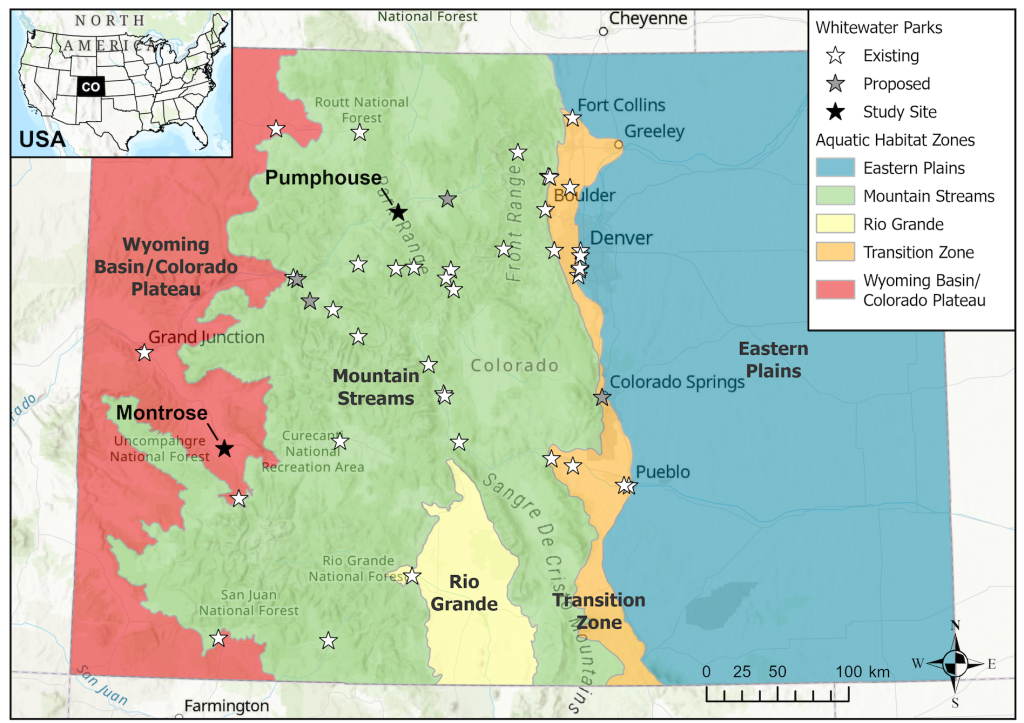
Researchers studied whitewater park structures at the Pumphouse Recreation Area on the Colorado River and at the Uncompahgre River near Montrose


Colorado Parks and Wildlife/Courtesy photo
Editor’s note: This article has been updated to correct a typo.
A new study by Colorado Parks and Wildlife researchers suggests man-made whitewater parks that create “play waves” for kayakers and other recreationists are having a negative impact on fish passage.
Colorado’s rivers are well-loved by both whitewater enthusiasts and anglers. Yet, as whitewater parks have been constructed throughout the state, researchers say the potential impacts on fish and anglers have not always been taken into consideration.
“Essentially, they’re kind of at odds,” said Eric Richer, an aquatic research scientist with the state wildlife agency and one of the lead authors of the study. “Fish want slow, deep water and whitewater parks, to create the hydraulic wave, are constricting water into a steep chute or drop, often over a surface that has been grouted to try to make it as smooth as possible to get those velocities elevated.”
Whitewater parks
Over the past two decades especially, white water parks — which are typically constructed by inserting concrete slabs or grouted boulders into the river to create a narrow chute — have increased in popularity across the state. Many local governments have constructed whitewater parks as an economic draw to help attract recreationists.
The state wildlife agency first began looking into the impacts of white water parks on fish passage a number of years ago after one scientist who is an avid angler was fishing near the white water park on the Arkansas River near Buena Vista, Richer said. The researcher noticed that he was catching more fish downstream of the man-made structure than he was as he worked his way upstream through the structure.
Researchers identified more than 40 white water parks across Colorado that are either already built or are in the planning stages. There are whitewater parks on the Colorado River near Glenwood Springs, the Roaring Fork near Basalt, the Ten Mile Creek in Frisco, the Pumphouse in Gore Canyon near Kremmling and dozens of other locations.
“It’s a draw to a river, and it’s good — you’re getting people outside and in nature,” Richer said. “The biggest concern we’ve found through our research is that water parks can suppress fish movement. So our advocacy has been to incorporate fish passage structures or fish ways around these white water park features to ensure that fish can move upstream at these locations.”
Modeling fish movements
The study, published in the peer-reviewed journal “River Research and Applications,” looked at two white water parks that have incorporated fish passage structures into the design: One at the Pumphouse Recreation Area on the Colorado River in Grand County and the other on the Uncompahgre River near Montrose.
Colorado Parks and Wildlife became aware of these two projects through the U.S. Army Corps of Engineers permitting process and was therefore able to design a study that modeled fish movement before and after the construction of the white water parks.
To study the impact of the white water park structures on fish passage, researchers completed detailed surveys of the channels at both sites before and after the construction of the park structures. The scientists then used a two-dimensional hydraulic model to look at water depths and velocities, which they compared to fish passage criteria for three species of interest at different stages of their life cycles.
The three fish species studied were brown trout, which represented the “target recreational species,” Colorado sculpin, a small, bottom-dwelling fish that are a “good indicator of ecological health” and flannel-mouth suckers, a “larger-bodied, weaker-swimming” fish that is native to the state’s rivers and is of conservation concern, Richer said. The researchers drew from existing literature to estimate the body-size and the maximum swimming speed of each species at three stages of their life cycles: juvenile, average adult and large adults.
“Generally to get through a white water park structure it’s a relatively short distance of a few meters,” Richer said. “So, our assumption is that fish would be using their burst or sprinting swimming capabilities. So, they’d be swimming as fast as they possibly can.”
Using the river model, researchers essentially drew a line downstream of the whitewater parks and another line upstream of the structures, then used a Geographic Information Systems tool that found the easiest route to get from the downstream location to the upstream location. The team repeated this until there were no more paths from downstream to upstream, before iterating it again the same number of times, but using the model of the river prior to the construction of the white water park.
The researchers then used another tool that compared the minimum depth along each route to the size of the fish and the water velocity to the maximum swim speed of the fish to determine whether each fish species at each life stage would be able to make it upstream.
“We were able to model the passage probability and the passage probability always decreased for all species, all life stages, all flows, both sites, from before to after,” Richer said. “So that’s suppression of movement. Then, the next question is: ‘Was it a complete barrier?'”
After white river park construction, brown trout, the strongest swimmers, maintained the highest proportion of passage probability, about 23%, followed by sculpin, about 15%. For suckers, the parks appeared to be an almost complete barrier, with only 2% passage probability, according to the study. Adult trout appeared to have higher rates of success making it upstream of the structure in the models, juvenile trout appeared to have a harder time.
Real-world impacts
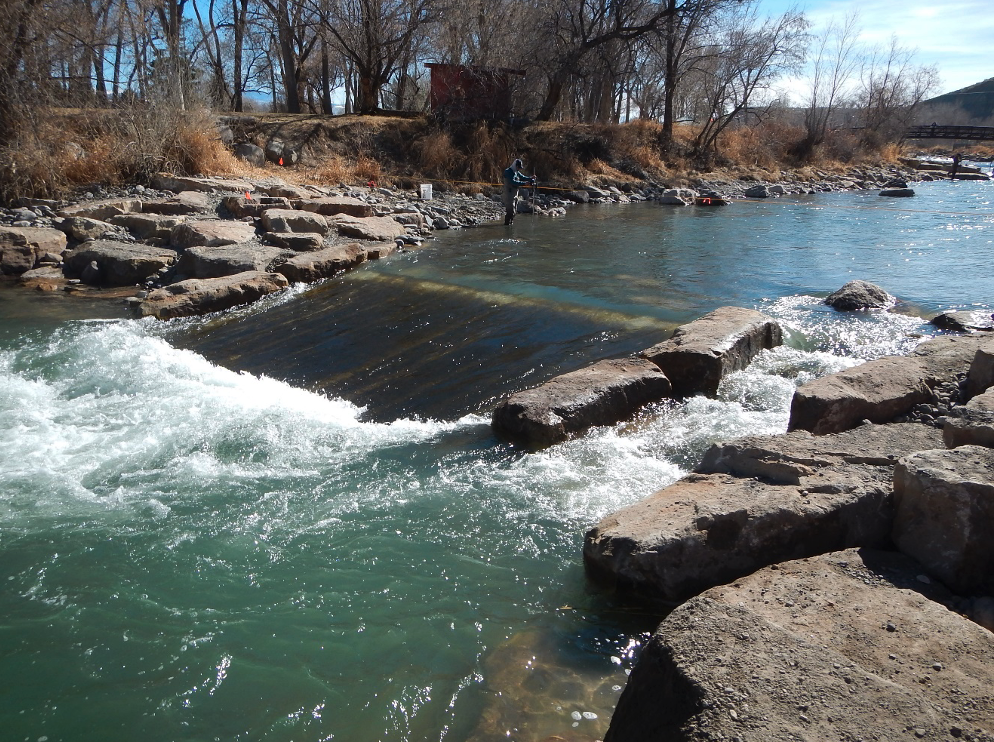
In addition to using models, the researchers also captured fish at the Pumphouse site, marked the fish and moved them downstream of the whitewater park structure, then came back a year later to see how many of the marked fish had made it upstream of the structure.
Again, adult trout appeared to make it upstream past the whitewater park while fewer juvenile trout succeeded in doing so. There was also a higher concentration of suckers below the structure than above it, suggesting the park could be impacting the suckers’ movement.
Richer suggested that those constructing whitewater parks work with interdisciplinary teams with expertise in environmental engineering, hydrology, hydraulics, geomorphology and fish biology.
Whitewater sports don’t need to be at odds with fishery health and the angling industry, he said, so long as fish passage structures are designed in a way that takes into consideration the local fish populations’ needs.
“We can work together,” Richer said. “You don’t need a lot of water to create a fish passage. So give us a little water for the fish and you can still have a nice recreational playwave, but the key is having those conversations early in the process of developing that project.”



Support Local Journalism
Support Local Journalism
The Sky-Hi News strives to deliver powerful stories that spark emotion and focus on the place we live.
Over the past year, contributions from readers like you helped to fund some of our most important reporting, including coverage of the East Troublesome Fire.
If you value local journalism, consider making a contribution to our newsroom in support of the work we do.