‘Beetle-mania’: Colorado scientists and citizens question state officials’ claim that beetle-killed forests increase wildfire risk
Bark beetles like the mountain pine beetle are native species that have co-evolved with specific host species of trees in the West, according to experts

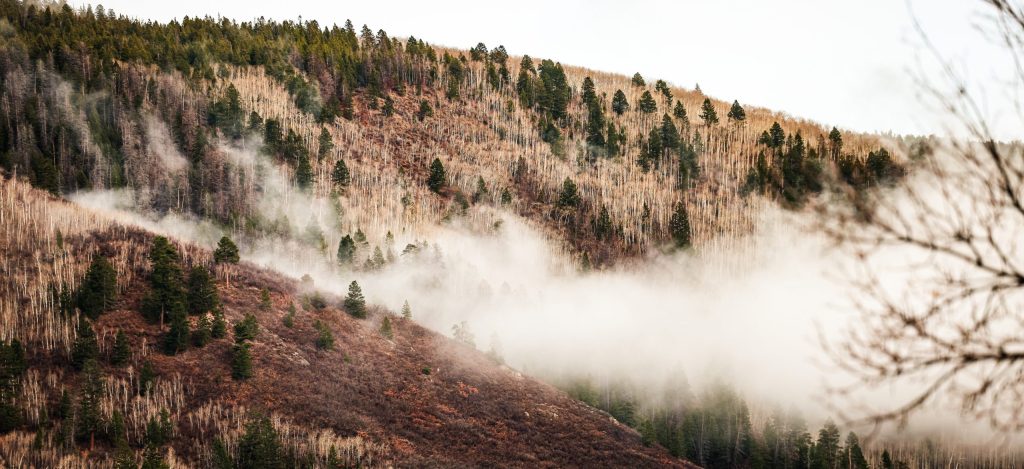
Austin Colbert/The Aspen Times
Some scientists and Colorado residents are raising concern that the state’s messaging and management of beetle-killed forests do not align with the published research on the interaction between dead trees and wildfires.
Mountain pine beetle impacts are receiving renewed attention after Colorado Gov. Jared Polis issued an executive order in December to assemble a task force aimed at responding to a beetle outbreak affecting ponderosa forests on the Front Range.
“Colorado has long been a leader in forest health and fire mitigation efforts, and this is no exception,” Polis said in a news release announcing the executive order. “As the latest outbreak of pine beetles begins to take shape along the densely populated Front Range, we are taking an aggressive approach to boost tools and partnerships to protect our communities, forests, and key water sources, and equipping homeowners with the resources they need to protect their homes.”
Aerial forest health surveys conducted last year by the U.S. Forest Service and Colorado State Forest Service reveal a “significant and expanding mountain pine beetle outbreak in Ponderosa pine forests up and down the Front Range,” according to the news release. In addition to creating a task force focused on the beetle outbreak, Polis’ Office said it will seek to extend funding for “critical wildfire mitigation” and tax incentives for companies to remove beetle-killed trees for use in products.
The news release states that beetle-killed forests increase the wildfire risk to communities and claims that “early action is essential to reducing long-term fire risk” because “as mortality increases, standing dead timber can intensify fire behavior.” The release quotes state and federal officials, as well as agency heads, some of whom repeat these claims.
However, interviewed scientists and a review of published research on the topic, refutes the common premise that trees killed by mountain pine beetles are more susceptible to wildfires and increase wildfire severity. Some peer-reviewed research on the topic suggests that beetle-killed trees can be less flammable.
Thomas Veblen, a retired University of Colorado Boulder professor who has studied mountain pine beetle outbreaks and wildfires in Colorado, was among those who were frustrated by the claims made by the Governor’s Office.
“The messaging that is aimed at alarming the public about increased fire risk due to beetle-caused tree mortality is not consistent with the published research,” Veblen said. “What has been left out of the press releases on this, or the one press release, is some summary of what was learned from the previous beetle emergency from the late 1990s through the early 2000s.”
The Governor’s Office forwarded emailed questions from The Aspen Times regarding the wildfire risks of beetle-killed forests to the Colorado State Forest Service and state Department of Natural Resources.
After consulting with experts, state Department of Natural Resources Communications Director Chris Arend said, the “likelihood of wildfire (annual burn probability or chance of a fire starting) doesn’t change due to beetle activity. Arend added, “it is worth acknowledging that research on the interactions between beetle-killed trees and wildfires is evolving.” More research is needed, he said, noting that the issue is “nuanced.”
The news release from Polis’ also notes that “beetle-killed trees can create hazards for firefighters, hikers, utility providers, and local infrastructure” and that many of the areas most vulnerable to beetle kill are located near “densely populated communities within the Front Range foothills.”
A spokesperson for the Governor’s Office did not return a request for comment before publication regarding why the news release suggests that beetle-kill trees increase fire risk, when the science and the state’s own experts don’t show that.
Scientists say mountain pine beetles are natural, help biodiversity
Bark beetles are native species that have co-evolved with specific host species of trees in the West, according to the Colorado State Forest Service. Mountain pine beetles tend to attack ponderosa pines and lodgepole pines.
Veblen began researching the interaction between bark beetles and wildfires in the late-1980s, developing a technique of “tree ring reconstruction” that shows prehistoric wildfires and beetle outbreaks going back to the 1600s. He said his studies showed that regional-scale bark beetle outbreaks and high-severity wildfires are not unprecedented in the mountain West and have occurred for centuries, especially during extreme drought conditions.
“If you look at the tree-ring records of fires over the last several centuries, we have not seen a significant increase in either pine beetle outbreak or fire activity, compared to the 19th century or earlier,” he said.
That may be surprising since wildfires like those that occurred in 2020 in Colorado have been described as unprecedented, but the tree records show that “very large, high-severity fires” are “business as usual,” he said, especially in high-elevation forests. He pointed to an example when the entire western side of what is now Rocky Mountain National Park burned in 1851, encompassing nearly all of the current zone of lodgepole pine around the town of Grand Lake.
What is different in the 21st century is that more people live in these mountain areas and the impacts of climate change are resulting in drought conditions becoming more common and occurring with more regularity across the West, he said. He noted that drought conditions also weaken trees’ defenses, making them more susceptible to beetles, and warmer winters may result in increased beetle survival.
“We know warming temperatures are creating conditions that are more conducive for bark beetle outbreaks,” Veblen said. “So it’s likely that over the next several decades, we’re going to see abundant beetle activity, but it’s not completely unprecedented.”
Dominick DellaSala, a senior conservation scientist at the California-based Conservation Biology Institute, has studied forest ecosystems across the Western U.S., including the Rocky Mountains.
The lead author of a recent scientific paper entitled, “Removing dead trees will not save us from fast moving wildfires,” DellaSala said the common assumption that beetle-killed trees increase wildfire risk has not been proven.
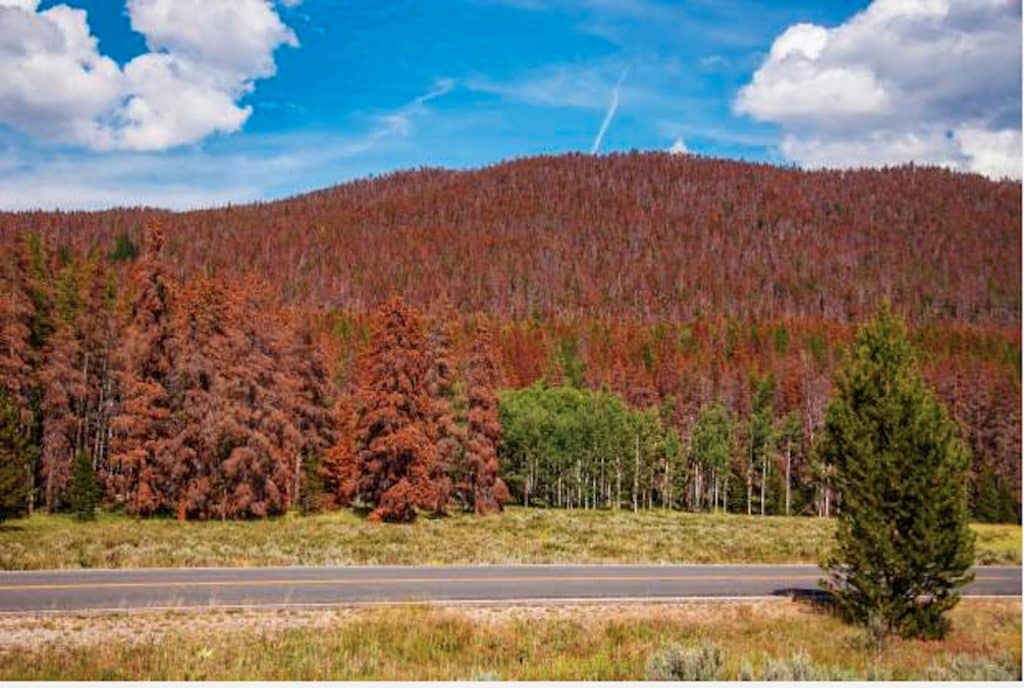
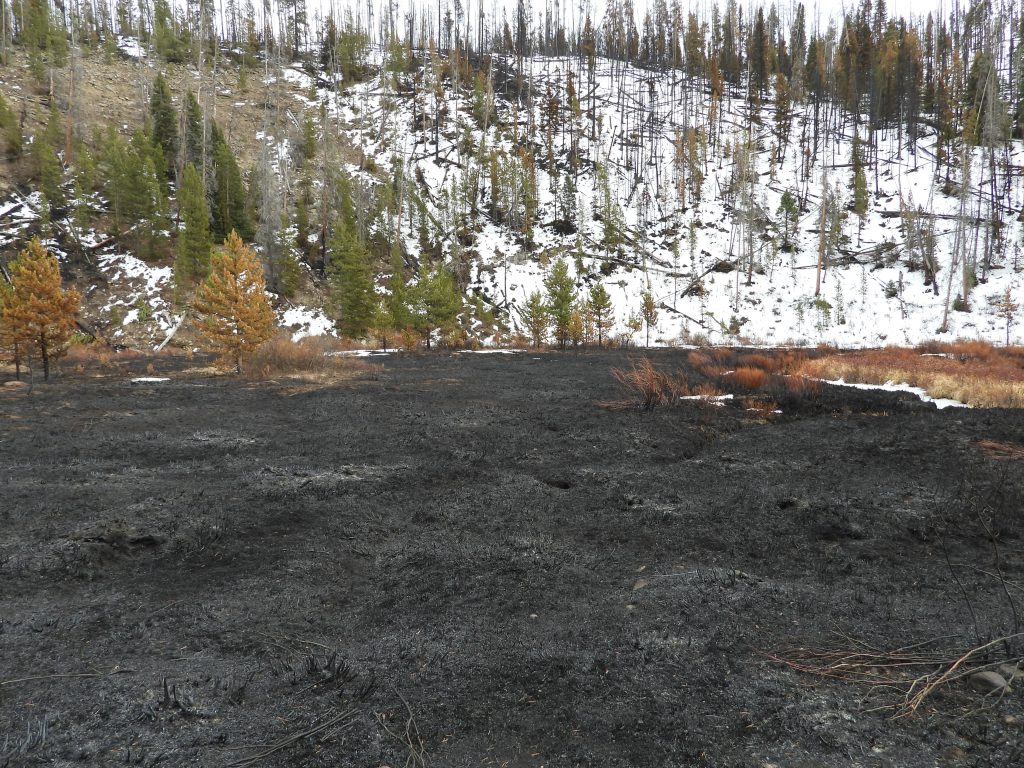
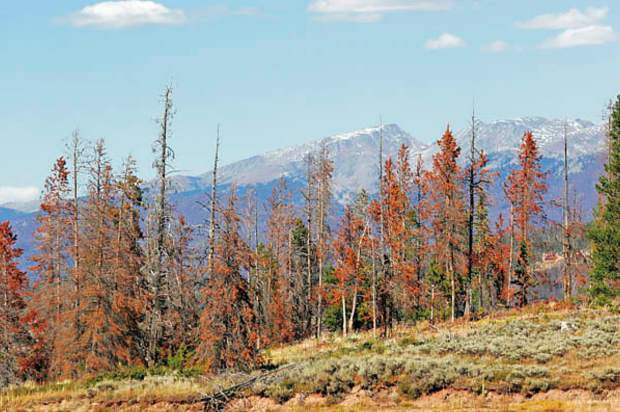
“Contrary to what most people think, dead trees lose their flammable properties very shortly after they go through their needle phase,” he said. “So they have a red-phase and a gray-phase in terms of how the needles change colors. Once those needles drop out of the canopy, which is one to three years … they’re no longer flammable. There’s no live fuel in the canopy to cover a crown fire.”
Arend, the state Department of Natural Resources communications director, noted that while “annual burn probability is unaltered” in beetle-killed forests, “what does change is that surface fire can transition to crown fire under a wider range of environmental conditions and lower wind speeds.” He also noted when red needles are in the canopy they can have a “lower foliar fuel moisture” and “may facilitate a transition in fire type from surface to crowning under a wider range of fuel moisture conditions and lower wind speeds.”
Forests with dead trees are not actually dead, DellaSala said, noting that ecologists recognize that these forests have “exceptional biodiversity.” He said policies aimed at removing dead trees, such as those killed by beetles, from the landscape may hurt, rather than help, ecosystems.
While policy makers and forest managers often see removal of dead trees as an “easy solution” that the public is generally in favor of, he said he believes that dead tree removal tends to be more focused on economics than reducing wildfire risk. He noted that companies that remove dead trees tend to want to remove trees before they start to decay and often want to remove the largest dead trees, which are the most profitable but also the most valuable to ecosystems.
“Instead of just saying, ‘Hey, we’ve got economic interests,’ they cloak it in misinformation that these trees are going to all burn up and they’re contributing to fast fires,” he said. “In fact, we know that the science, much of which has been developed in the Rockies, says the opposite is the case.”
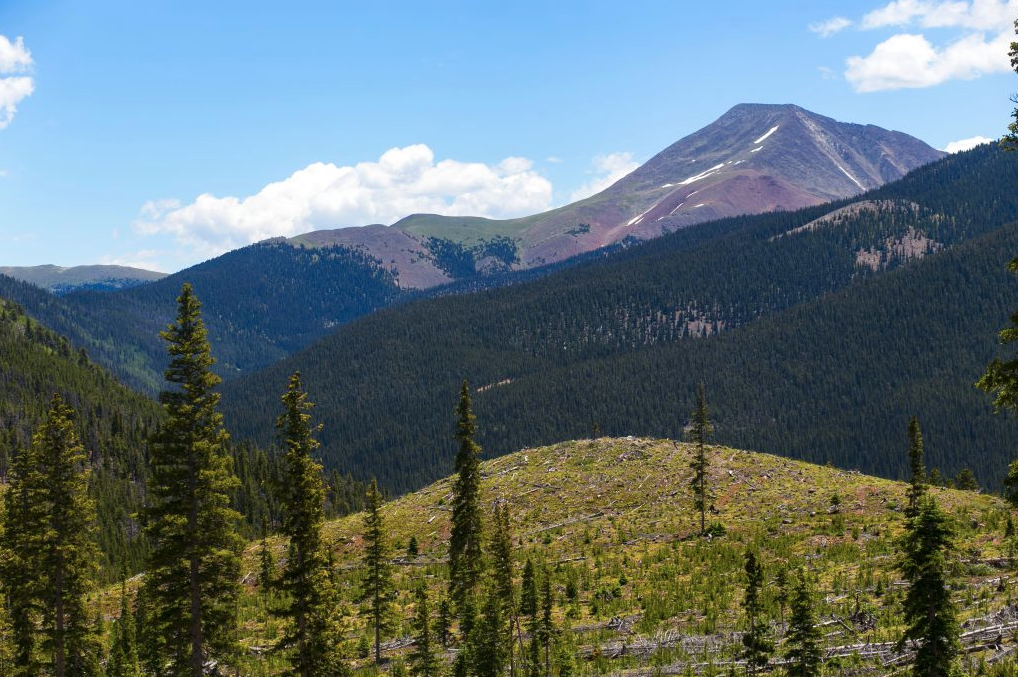
Arend, the state Department of Natural Resource communications director, in response to questions about the state’s beetle-kill tax incentives said, “there is positive feedback from industry partners and the number of manufacturers that apply for the exemption that they benefit from them.”
The state Department of Natural Resources claimed that salvaging beetle-killed trees and converting them into forest products “can store carbon” that would otherwise be released through decomposition or burning in a wildfire.
“Mountain pine beetle outbreaks result in many dead trees, so there are both economic and ecological benefits to utilizing some of that beetle-killed wood than allowing it to decompose by turning them into forest products, and tax incentives encourage that,” Ardened said. “… Bark beetles don’t necessarily drive wildfire risk, but the dead trees can significantly add to fuel loads, and programs like this provide an incentive to remove some of this fuel from the affected forest and reduce fire intensity.”
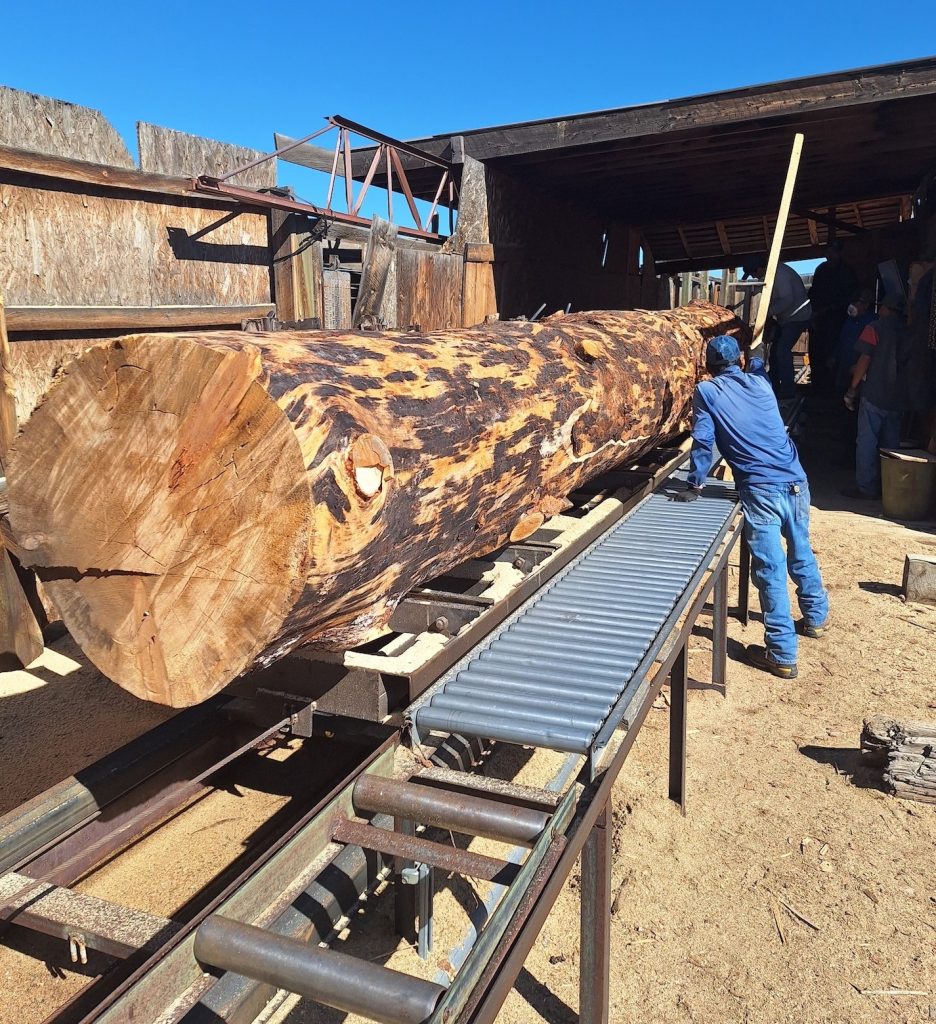
DellaSala and Veblen both questioned the efficacy of forest “thinning” and “fuel reduction” projects such as those that occur across Colorado. While these types of projects may reduce wildfire risk under some conditions, wildfires in Colorado tend to be driven by extreme fire weather — or a combination of dry conditions and high winds.
“Thinning really isn’t going to work under those conditions,” DellaSala said. “You’re going to actually have more impacts on forests, especially if you don’t dispose of the slash, and you’re not going to get all of it, because it’s costly to get rid of that slash. Then you have impacts to the soil, impacts to wildlife habitat.”
Veblen said that removal of hazardous dead trees that could fall near trails, campgrounds or infrastructure, “makes sense,” but that there is little evidence to support that projects focused on backcountry areas away from communities reduce wildfire risk.
Both noted that there is evidence showing that home hardening and creating defensible space, or buffer zones around residential properties, are the best ways to protect communities from wildfires. Both also noted that decommissioning or closing roads, which studies have shown increase the chances of wildfires starting due to human causes, could also reduce wildfire risk.
The state Department of Natural Resources also cited home hardening and defensible space as important strategies.
“Hopefully people on (the Governor’s) task force will be interested in ‘Hey, this is where we can really have an impact, let’s put our resources there,’ rather than continuing to do what is sometimes referred to as paddling upstream, reducing fuels in the hope that that may prevent fires from spreading,” Veblen said.
Citizens continue to raise questions
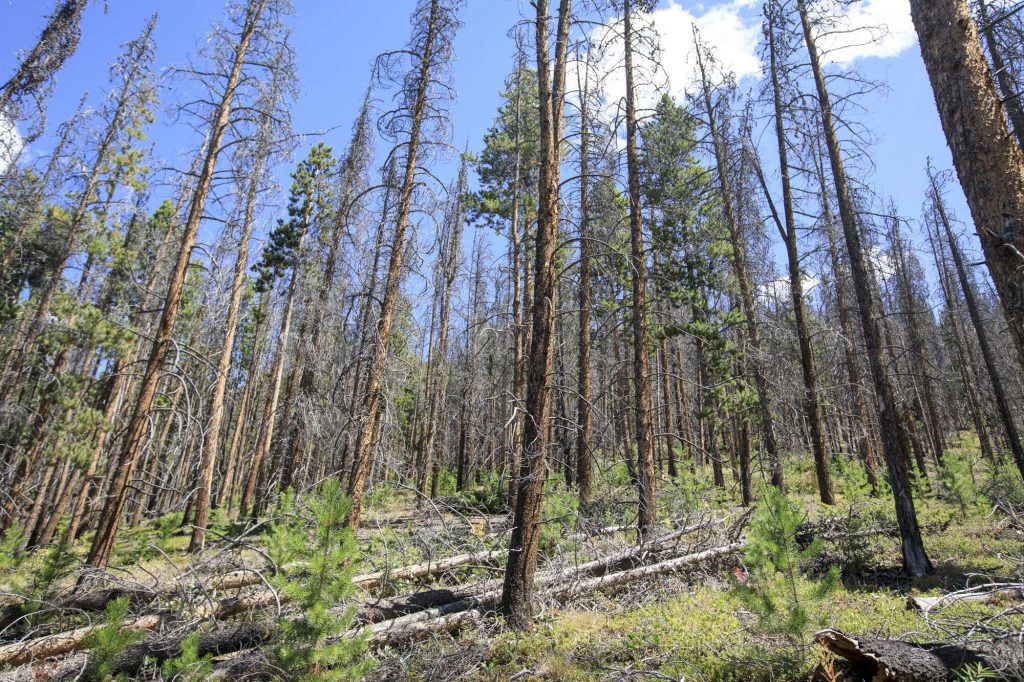
Howard Brown, a resident of the Silverthorne area, first started speaking out about forest management projects in around 2015, when a mountain pine beetle epidemic decimated Summit County’s lodgepole pine stands.
Brown, a former environmental policy analyst for the Congressional Research Service, said he became concerned about the U.S. Forest Service’s proposal to clear-cut a 1,500-acre area near Breckenridge and Frisco in the name of wildfire prevention. He spearheaded a petition that gathered dozens of signatures of residents opposed to the project, but the petition was unsuccessful at stopping it.
Despite widespread fears that beetle-kill would increase wildfire risk, he said that Summit County has not seen major wildfires in the more than a decade since that previous beetle outbreak. He noted that most wildfires in the county are human-caused and suggested that banning campfires, while unpopular, would prove more effective at reducing wildfire risk than forest management like “thinning” or “fuel reduction” projects.
“The threat of fire (due to beetle-killed trees) is really a red herring,” Brown said. “It’s a false pretense being used to scare people and get away with destroying the forest for very dubious purposes.”
Nederland resident Josh Schlossberg is the Colorado advocate for the Eco-Integrity Alliance, a grassroots advocacy organization that calls for limiting management in favor of “ecological balance” on public lands.
Schlossberg referred to the widespread concern that beetle-kill will increase wildfire risk as “beetlemania.” He said he was surprised to see the Colorado government repeating the same talking points that were raised more than a decade ago, despite no evidence that the previous wave of beetle-kill increased wildfire risk.
“The beetles come in and they’re doing their job and they’re being demonized,” he said. “They’re native wildlife that have always been here that are creating that structure. Nature knows what it is doing. Nature has been here for hundreds of thousands to millions of years before the first humans set foot on this continent. We have to trust nature.”
Both he and Brown said that they’re concerned that government leaders and the logging industry are taking advantage of the fear of wildfires to advance policies and management goals that don’t actually reduce the wildfire risk for communities.
Schlossberg encouraged Colorado residents to get involved at a local level to encourage policy makers to seriously consider whether forest management projects will result in reduced wildfire risk or not.
“Take your healthy skepticism and apply it to what is happening on our last best ecosystems on public lands,” he said. “People moved to Colorado because of the ecosystems. It seems like so many Coloradans are just willing to look the other way or have not been made aware of this.”

Support Local Journalism
Support Local Journalism
The Sky-Hi News strives to deliver powerful stories that spark emotion and focus on the place we live.
Over the past year, contributions from readers like you helped to fund some of our most important reporting, including coverage of the East Troublesome Fire.
If you value local journalism, consider making a contribution to our newsroom in support of the work we do.