Western Slope teacher-turned-lawmaker’s bill seeks to protect online ‘kidfluencers,’ mirror efforts in other states
Bipartisan legislation sponsored by Rep. Meghan Lukens, a Steamboat Springs Democrat, would ensure children who appear in monetized online content are paid for their work, along with other protections

Robert Tann/The Aspen Times
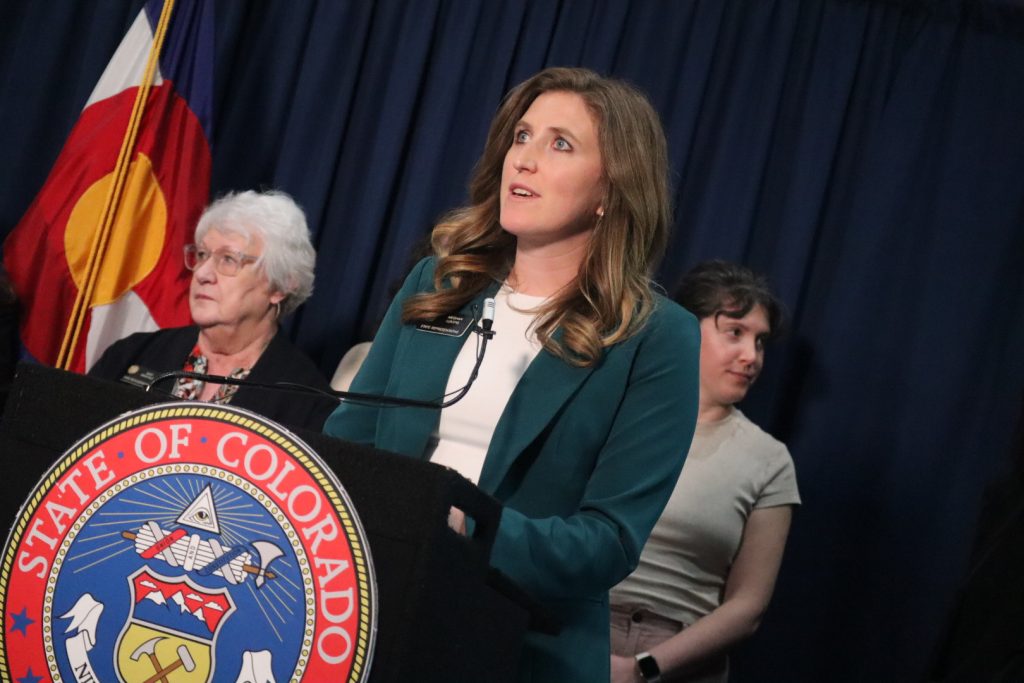
Colorado lawmakers are mapping out a plan to ensure children who appear in monetized online content, sometimes called “kidfluencers,” make money for their work and receive additional protections.
House Bill 1058 would require parents or guardians to establish a trust fund for children younger than 18 who appear in digital content, allow those children — once adults — to remove that content, and beef up civil enforcement against child sexualization.
The measure is sponsored by Reps. Meghan Lukens, D-Steamboat Springs, and Scott Slaugh, R-Berthoud, as well as Sen. Matt Ball, D-Denver.
Lukens, who, before being elected to the legislature in 2022, served as a social studies teacher at Steamboat Springs High School, said in an interview on Thursday that she’s seen firsthand the “negative and wide-ranging impacts that social media has on kids, whether that be a negative impact on the learning environment or a kid’s mental health.”
That led her to champion several bills aimed at regulating children’s phone and social media use, including a 2025 measure requiring Colorado schools to adopt district-wide student phone policies.
Lukens’ latest bill, HB 1058, comes in response to a proliferation of online content featuring minors, often created by adults to net lucrative brand deals and bolster their influencer status. The bill is modeled after similar legislation passed in Illinois, California, Minnesota and Utah.
Under HB 1058, parents or guardians would be required to establish a trust fund for children who appear in online content where the creator earns $15,000 or more within a year. Children aged 14 and older who create their own content could do so without having to establish a fund for themselves.
To receive a trust, children would need to appear in at least 30% of the content being produced within a 30-day period, and that content must also meet the required monetization thresholds on a given platform or generate at least 10 cents per view. How much money is put into that trust would depend on how many children appear in the content. For one child, it would be 50% of gross earnings, while multiple children would receive 50% of earnings divided equally among them.
HB 1058 also establishes more guardrails for protecting children online. The bill allows adults who appeared in content as children to request that their information be removed, with social media platforms providing a removal process request. It also creates a path for state civil lawsuits against content creators who knowingly sexualize children for financial gain.
Lukens said it’s important that lawmakers act to protect children growing up in a largely unregulated digital age. HB 1058 represents just one of the many areas where she says legislators have the ability to mitigate harm.
“Tackling the harms of social media is the challenge of our generation,” Lukens said. “That is why it’s important to chip away at this new world that we live in — this new, tech-savvy world that we live in — and ensure that we as people are protected, especially kids.”
HB 1058 is supported by some of the world’s largest tech giants, including YouTube and TikTok U.S. Data Security Joint Venture, the newly formed U.S.-owned branch of TikTok.
During a Tuesday hearing on the bill before the House Judiciary Committee, Melissa Fausz, YouTube’s manager for state and local government affairs and public policy, said the bill provides “a balanced approach.”
“(The bill) places reasonable expectations and responsibilities on both creators and platforms,” Fauz said.
Lawmakers on the Judiciary Committee voted 11-0 to advance HB 1058 to a full House vote, but not before posing questions on implementation and enforcement.
Several lawmakers asked how the bill would ensure that parents and guardians, and social media companies, would follow the law.
Some suggested that platforms should deploy a notification for when a content creator has met the requirements needed to open a trust fund. Lawmakers also wanted to ensure that the bill would capture revenue derived from advertising and brand deals, not just views, and asked how a child could hold their parents accountable if they do not receive payment.
Lukens said adults who appeared in content as children would be able to sue their parents once they turn 18 if they failed to set up a trust or if other provisions of the bill were violated.
Rep. Lorena Garcia, D-Adams County, questioned how feasible it is for a child to wait until they’re 18 to pursue legal action, especially if the content they appeared in is removed before then. Garcia also asked if the bill sponsors would consider adding other family members, like aunts and uncles, to the list of adults who have to provide compensation to children for their content.
Lukens said she remains open to ways to improve the bill, and signaled there may be more amendments as it works its way through the legislative process.
During her interview on Thursday, Lukens said the legislature has pursued several avenues for mitigating harm to children online, not all of which have been successful.
A bill she sponsored last year that sought to place more responsibility on social media companies to determine if users are children and take steps to protect their privacy and limit their exposure failed to advance. Another bill requiring social media companies to remove certain flagged content and publish reports on children’s online use, which Lukens co-sponsored, was vetoed by Gov. Jared Polis.
Lukens said regulating social media remains a legislative imperative in the U.S. and across the world.
“Elected officials in different capacities — that ranges from from school boards, state legislatures to federal governments — are working to address this issue, and everyone is taking different avenues,” Lukens said. “When one state passes something in any space, other states are looking at that and saying, ‘That’s a good idea, what can we do in our region to address that same problem?'”











Support Local Journalism
Support Local Journalism
The Sky-Hi News strives to deliver powerful stories that spark emotion and focus on the place we live.
Over the past year, contributions from readers like you helped to fund some of our most important reporting, including coverage of the East Troublesome Fire.
If you value local journalism, consider making a contribution to our newsroom in support of the work we do.