Denver-based energy and transit firm unveils ambitious plan to connect Grand County with the Front Range
The proposal would involve hydrogen-powered trains funded through residential solar power

STE-Holdings/Courtesy image
The first bore of the Eisenhower Tunnel opened in 1973, cutting commute times to Summit County and reshaping the region. Originally known as the Straight Creek Tunnel, the project provided direct access to the west side of the Continental Divide in central Colorado and turned once-remote mountain towns into hives of tourism, commerce and residency.
Now, a new proposal, called I-70 Mountain Express, hopes to do the same for Grand County.
The wide-ranging project, envisioned by Denver-based STE-Holdings, could include a hydrogen-powered railway running from Golden to Breckenridge and Winter Park. The plan includes carbon-neutral travel to reduce highway congestion, affordable housing construction and large-scale solar energy production.
“We think this is a very transformative project for Colorado,” STE-Holding’s cofounder Dave Ruble said as he presented the plan at the Dec. 9 Grand County Board of Commissioners meeting.
The company began in 2015 as Rocky Mountain Rail before rebranding. While STE-Holdings has not completed any rail projects since its formation, Ruble said it has spent the past decade developing a viable funding model. The company also operates a nonprofit arm, Sustainable Systems Colorado, formed in 2010 to accept tax‑deductible contributions.
The Mountain Express plan
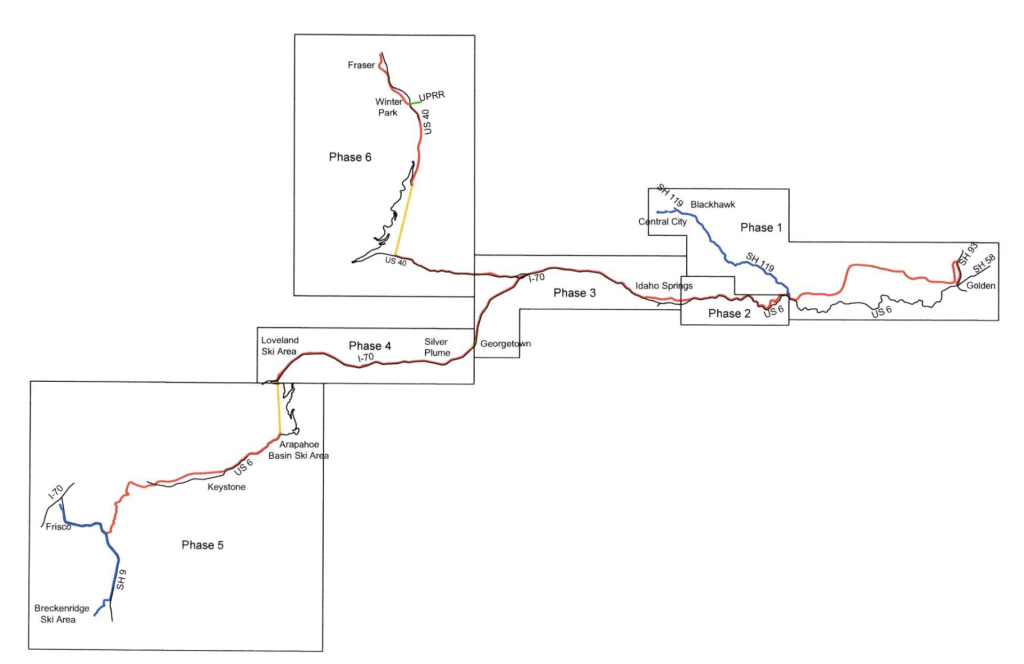
STE-Holdings’ plans show the project unfolding in six phases. It would start with a rail line from Golden to Blackhawk and Central City, extending westward through Idaho Springs, Georgetown and Loveland Ski Area before reaching Breckenridge.
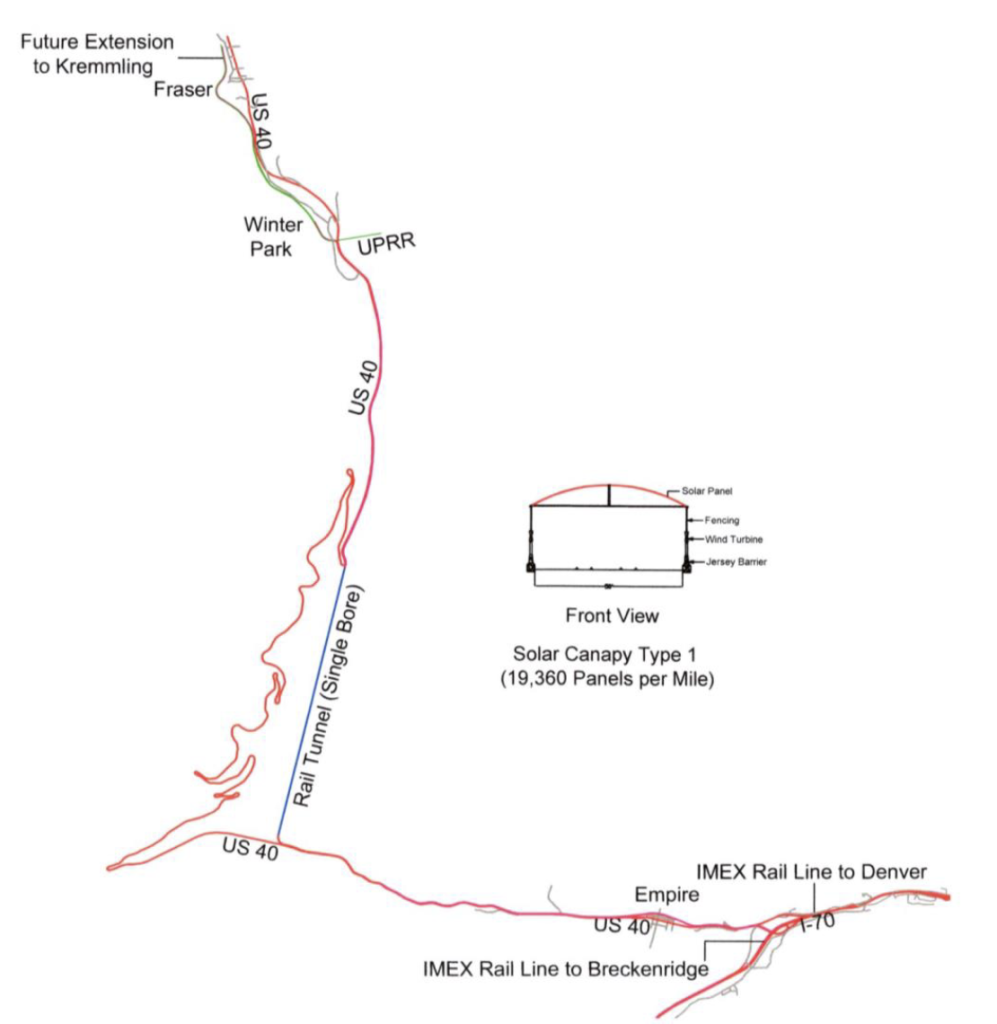
The final phase would push north to Winter Park with a tunnel under Berthoud Pass and plans to link the line to the existing rail near Fraser, though the company has not discussed its plans with Union Pacific.
Each stage would send hydrogen-powered train lines, canopied by solar panels, to Colorado mountain towns. If the project comes to fruition, the full build-out would span more than 100 miles and include 28 stations.
Ruble projects annual ridership of nearly 13 million passengers. He said he came up with the ridership estimate based on traffic data from the Colorado Department of Transportation.
Funding the proposed project would not rely on taxpayer dollars. STE-Holdings instead plans to fund the entire $12 billion system through solar energy revenue.
“We need 236,000 homeowners to agree to let us put 20 solar panels on their homes,” Ruble said. “That’s enough for us to do this project.”
Ruble said the company has not yet secured financing for the panels and may need a line of credit to fund the first 10,000 installations.
Participating homeowners would then pay STE‑Holdings directly for electricity at a fixed rate of 16.5 cents per kilowatt‑hour for 25 years with a 2% annual escalation clause. He said the company would own and maintain the panels and batteries, and that excess electricity would be sold to help fund rail operations.
Ruble added that he expects rail fares would be modest: $5 from Golden to Blackhawk, and $15 from Breckenridge to Denver. He calculated fares at 25 cents per mile, making them competitive with the existing Black Hawk shuttle.
Additional infrastructure
The Mountain Express vision extends beyond transportation infrastructure. The company hopes to build workforce and senior housing near stations, generate tens of thousands of jobs through construction and lay the groundwork for a hydrogen-based economy that would reduce greenhouse gas emissions.
Chris Ellis — director of education for In Our Hands, a nonprofit focused on sustainable building techniques — agrees with STE‑Holdings’ view that the project could be transformative, noting that combining solar, hydrogen and community development offers a holistic path toward long‑term sustainability and education.
Ellis noted that the housing component could be especially impactful for ski towns struggling to retain workers.
“Affordable housing is a pretty key part of their proposal,” Ellis said.
He pointed out that by focusing on the benefits the plan could have for ski communities, STE-Holdings may have a better chance of overcoming legislative barriers. According to Ellis, those barriers include political resistance from existing energy interests and the challenge of changing long‑standing utility and transportation policies.
Grand County phase
The final stage of the I-70 Mountain Express proposal pulls Grand County into the spotlight. It would carry the hydrogen-powered trains from an I-70 station up through a 3.6-mile tunnel beneath Berthoud Pass.
STE-Holdings projects nearly 2.7 million riders a year on the Winter Park extension. Ruble drew this number from CDOT’s traffic counts of about 8,000 vehicles per day traveling between Empire and Winter Park.
Grand County Commissioner Ed Raegner noted that the estimate would mean about 7,300 riders per day on the Winter Park line, a number he described as ambitious.
The proposal also envisions about 5,000 new dwelling units near Grand County stations. STE-Holdings proposes to reserve half of these for low-income and senior residents.
But Ruble cautioned that the numbers are preliminary.
“We just made a guess so we could give something for people to talk about,” he said, noting zoning would ultimately determine housing capacity.
For a region long strained by workforce housing shortages, this could be a relief and a reshaping force, altering Grand County’s demographics and density, Ellis said.
Ruble compared the potential impact to the growth seen in Summit and Eagle counties after the Eisenhower Tunnel opened, saying similar development could follow improved access to Grand County.
No small hurdles
With its bold vision, it’s unknown whether the I‑70 Mountain Express project will ever leave the drawing board.
Grand County Commissioner Randal George said the proposal struck him as both exciting and uncertain.
“It’s an ambitious project that would be fantastic if they were able to pull it off,” he said, noting that STE‑Holdings isn’t asking the county for funding.
He added that the company faces “some pretty good‑size hurdles,” especially its need to sign up hundreds of thousands of homeowners for its solar‑energy program. “It’s certainly doable,” George said, “but the likelihood is pretty slim.”
Land is the most immediate challenge. Securing rights‑of‑way along the I‑70 corridor and through mountain passes will require negotiations with private-property owners, local governments and state agencies.
“Our footprint is so small — 2-feet-by-2-feet piers elevated above the highway — that we think we can fit within the I‑70 right‑of‑way,” Ruble said, though cooperation from the Colorado Department of Transportation remains a question.
Ruble said CDOT has not engaged with the company and has declined past proposals, including a previous attempt to place a hydrogen line in the median of Colorado Highway 119, also known as the Diagonal Highway, which runs between Boulder and Longmont.
The financing model depends on installing nearly half a million solar panels on homes and businesses across Colorado. Without widespread buy‑in from property owners willing to host panels and commit to long‑term power purchase agreements, the funding stream could falter.
Technology approval is another barrier. Hydrogen‑powered rail is relatively new in the United States, and regulators will need to sign off on safety, reliability and environmental standards before trains can run.
“The trains are run by electric motors, but that electricity is produced by hydrogen instead of diesel,” STE-Holdings cofounder R. Paul Williamson explained at the meeting.
Ruble said that while the U.S. has been slow to adopt hydrogen rail, it has been successfully used in China, Japan, Germany and recently in California.
Ellis added that the most significant obstacles are not scientific. Instead, they’re political, with the project running counter to the interests of existing energy powerhouses.
“One of the biggest problems with any new technology is fighting the status quo,” Ellis said. “We can solve the problems. But will we because of politics and economics?”
The proposed rail line’s location along I‑70 also adds complexity. The corridor is already crowded with highway lanes, rivers and steep terrain. Ruble said STE-Holdings chose an elevated SkyTrain‑style system specifically to fit within the constrained corridor.
Then there is the production of hydrogen itself. To power the trains, the I-70 Mountain Express project must establish a reliable supply chain for hydrogen fuel, including generation, storage and distribution infrastructure in mountain environments.
“We’ll build enough solar power generation to make the hydrogen ourselves,” Ruble said. “We could even put a hydrogen pipeline along I‑70 as a backbone for fueling trains and cars.”
Ruble said hydrogen would be produced through electrolysis using solar power, with fuel stored at stations or transported via pipeline.
Even though the rail would be privately funded, political approval looms over the project. Environmental reviews, land-use permits and coordination with existing rail operators will all require political will. Local communities, too, will need to weigh in, and their support or opposition could shape the project’s fate.
“I really want to make Colorado a better place,” Ruble said. “That’s my only goal.”




Support Local Journalism
Support Local Journalism
The Sky-Hi News strives to deliver powerful stories that spark emotion and focus on the place we live.
Over the past year, contributions from readers like you helped to fund some of our most important reporting, including coverage of the East Troublesome Fire.
If you value local journalism, consider making a contribution to our newsroom in support of the work we do.