Fraser planning commission recommends denial of 1 application, denies 1 application for Grand Park development amid litigation
The developer and the town are currently embroiled in a legal battle over potential development of Cozens Meadow.

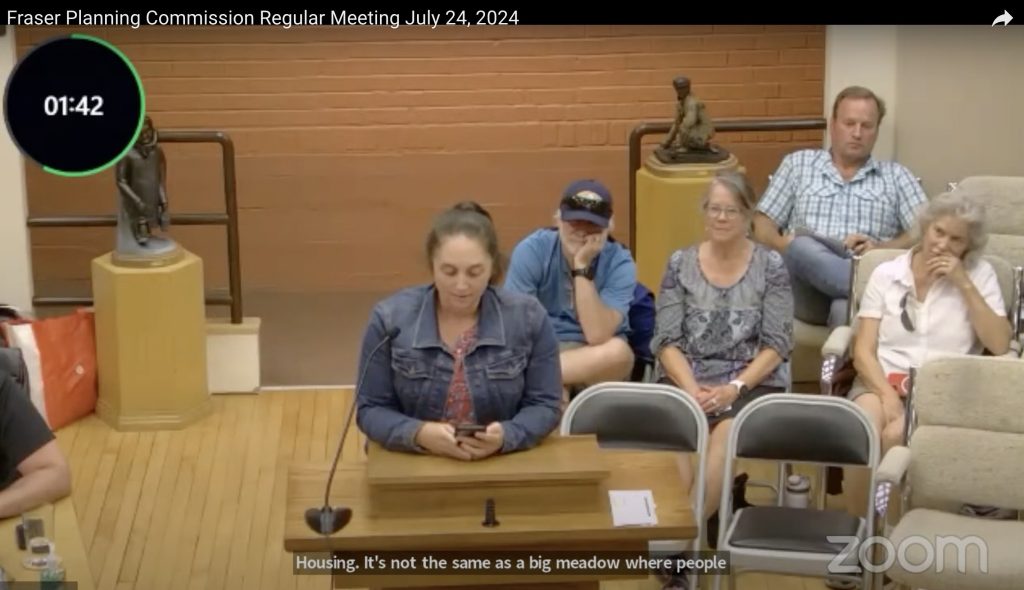
Town of Fraser/Courtesy photo
The Fraser Planning Commission has deliberated on land-use applications within the Village at Grand Park since January 2024. One application, referred to as Grand Park Filing 3, proposed development in Grand Park’s planning areas 1Wa and 2W. The other application, known as Grand Park Filing 4, proposed development only in Grand Park planning area 1Wa.
At the meeting, planning commissioners listened to presentations regarding both applications for preliminary plats and final planned development plans in the two areas of Grand Park. The applications requested new uses that included a combined total of 61 residential units, 540 lodging units and 73,365 square feet of commercial space. Clark Lipscomb, Grand Park developer, and Layla Rosales of Terracina Design gave the presentations.
What are preliminary plat and final planned development plan applications?
A final planned development plan is a detailed land-use plan that outlines building footprints, roadways and more. If approved, the developer moves to the next step, which is the preliminary plat that further delineates locations and shows compliance with town code.
Areas 1Wa and 2W include the Grand Park Recreation Center, Market Street buildings (currently under construction) and other land that amounts to approximately 72 acres. Some development in this acreage is already in use, such as the recreation center that is located in area 1Wa. Lipscomb also proposed new development in the recent applications.
This recent request created contention between the town and Grand Park, specifically over development in Cozens Meadow. The meadow stretches along U.S. Highway 40 and the Grand Park neighborhood in Fraser.
“This has moved a large set of buildings right out into what foreseen as open space,” said commissioner Andy Miller at the meeting, calling this move into the meadow as “way beyond the pale.”
At the July 24 meeting, the planning commission recommended denial of filing 3 and denied filing 4 after receiving significant public opposition and listening to detailed presentations by the developer. Mayor Brian Cerkvenik and trustee Peggy Smith did not vote. The two recused themselves because of comments they made about Grand Park in a March 2024 meeting. The comments, which were made before they were elected to the board of trustees this April, cast doubt on whether they could vote impartially.
“The images that I’ve just witnessed are atrocious,” Cerkvenik had stated of the proposed development plans at a March meeting.
Fraser Town Board of Trustees still must give final approval or denial for filing 3, weighing the planning commission’s recommendation against developing a portion of the meadow. Filing 4 will not advance to the board or trustees.
Grand Park’s development is governed by a planned development district plan that was created in 2005. This 2005 document amends a 2003 annexation agreement. The requirement to place Cozens Meadow in a conservation easement changes from the 2003 to 2005 document, although other plans have remained the same.
In their decision, the commissioners ultimately felt that Lipscomb’s applications deviated too far from the 2005 planned development district plan, which governs development in Grand Park. Some commissioners also felt that an entire amendment of the 2005 plan was needed since nearly two decades have passed, making some portions of the document irrelevant.
Town and developer embroiled in lawsuit over conserving a meadow
The planning commission has deliberated over the applications for the past seven months. Throughout this time, town staff also prepared for a trial with Lipscomb and various entities associated with the development. The trial, which lasts from Aug. 5-15, concerns potential development in Cozens Meadow, technically known as Planning Area 23W.
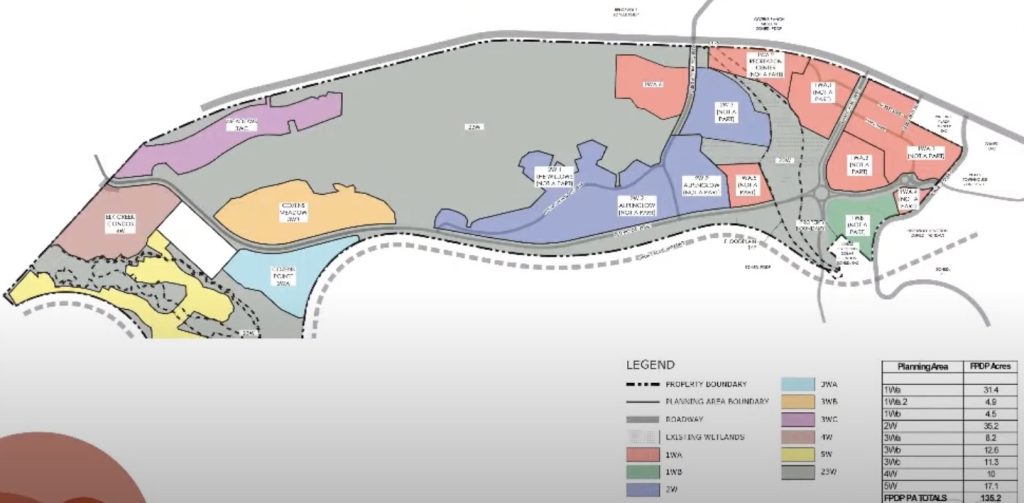
The fate of the meadow, owned by the developer, has been heavily contested by Lipscomb, the town of Fraser and its residents. It’s unclear whether a conservation easement is legally required. The 2005 planned development district plan makes no mention of an easement for the meadow, while a 2003 annexation agreement does.
At the bench trial, Grand County District Court Judge Mary Hoak will rule whether the developer is required to place Cozens Meadow into a conservation easement.
The meadow is zoned open space, meaning it could potentially be developed in the future if zoning changes. If a conservation easement is required, the meadow will never be developed, unless there is a lengthy court process to reverse it.
The battle between development and open space
At the July 24 meeting, Cozens Meadow became center stage. According to the town, Lipscomb’s “proposed plans encroach into Planning Area 23W which is designated open space and earmarked for conservation easement.”
For example, in filing 4 it proposed that a portion of area 1WA be included in Cozens Meadow. This proposal called for 44 residential units and 140 lodging units on 6 acres within the meadow.
According to Lipscomb, there’s value in these potential buildings.
“This is about more than developing real estate; this is about economic development for the town … I think we need more jobs in the community, we need more places for people to stay,” he told commissioners.
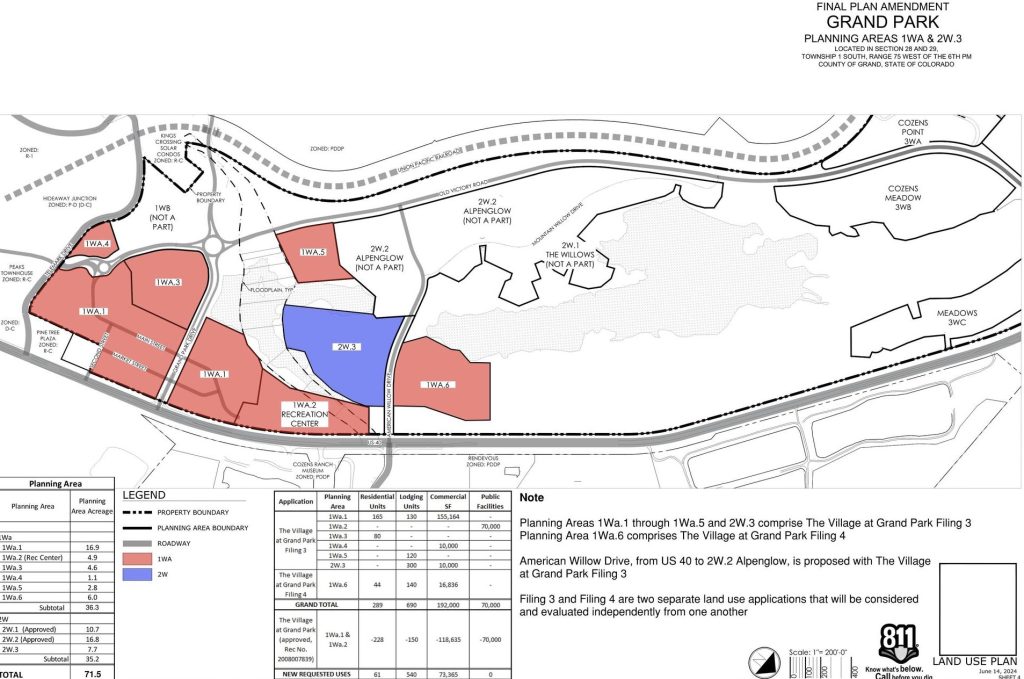
Lipscomb is in talks with a hotelier to build hotel lodging — potentially in Cozens Meadow with some heights of 75 feet. He added that the application’s conservative proposals, such as small buildings and underground parking, benefit open space and keep Grand Park “mostly green.”
“Twenty-three W is larger in size today in this submittal, than what is required,” Lipscomb said.
Residents who spoke in public comment at the July Fraser meeting disagreed with this. Several voiced their determination to prevent any part of Cozens Meadow from being developed, to preserve the land for wildlife and human enjoyment.
“I do think there’s been a bait and switch,” said Fraser resident Jennifer Anderson, referring to the new applications. “I don’t think you can say that landscaping throughout a big development is the same as a big meadow or has the same value to the public.”
What’s next for Grand Park?
Filing 3 — the preliminary plat and final planned development plan that includes 17 residential units, 400 lodging units and about 56,500 square feet of commercial space — isn’t dead in the water. The developer can take filing 3 to the Fraser Town Board of Trustees for consideration, no later than 45 days after July 24. Lipscomb can also request to amend the 2005 planned development district plan.
As for the lawsuit, Lipscomb appeared in Grand County district court on Aug. 5, as two sides disputed the fate of the meadow in downtown Fraser. Each attorney presented very different interpretations of documents related to Cozens Meadow.
At the witness stand, Lipscomb gave a brief history of the meadow and explained it was once owned by homesteader Billy Cozens, who utilized it as a cow pasture and hay meadow. Fraser has evolved into a bustling resort town since the days of homesteaders. Now the meadow is bounded by development, stretching along a busy highway.
How much will be left to look like it did in Billy Cozens’ day remains in question.





Support Local Journalism
Support Local Journalism
The Sky-Hi News strives to deliver powerful stories that spark emotion and focus on the place we live.
Over the past year, contributions from readers like you helped to fund some of our most important reporting, including coverage of the East Troublesome Fire.
If you value local journalism, consider making a contribution to our newsroom in support of the work we do.