Know before you go: A guide to your first day snowboarding in Grand County
Izzy Wagner Follow

Granby Ranch/Courtesy photo
In a place like Colorado, winter sports are a way of life, and there is no shortage of mountainous terrain to explore. But for a beginner, the endless options can be daunting.
Grand County’s resorts, Winter Park Resort and Granby Ranch, offer a range of experiences for beginners to get comfortable on their skis or board and progress from bunny hills to more challenging runs.
If you are brand new to downhill snowsports, or to Grand County, like myself, here’s everything you need to know to ace your first day on the mountain.
Getting geared up
The first step is getting the proper clothing and layering according to weather conditions. It will get colder the higher up the mountain you get, so keep that in mind before hopping on the lift. Granby Ranch and Winter Park each have beginner-only hills in lower areas, where conditions are milder.
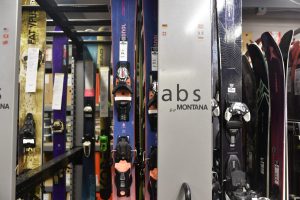
To help me pick the perfect snowboarding boots, I got a fitting, which gave me the ability to control the board’s response to my body movements. I kept my boots very tight and wore thin, synthetic socks designed for snowboarding.
I also got a board sized according to my height, weight and shoe size. I am 5-foot-6-inches tall and rented a 145 cm board, consulting a size chart with recommended rider weights to see what would work best.
Once the setup is complete, I was ready to strap in to my bindings. I opted for a large, since I am a size 8.5 boot.
From skating to riding: how to move on your board
Before strapping in, I determined that I was “regular,” not “goofy.” That is, I am right-foot dominant.
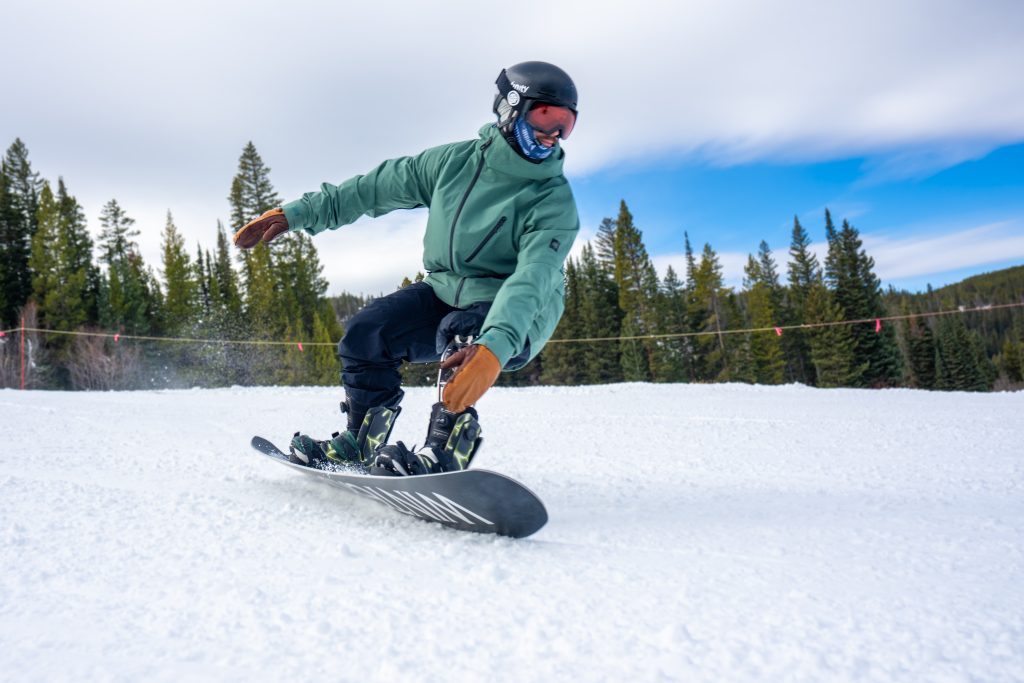
Once I figured that out, I strapped in by pushing my front foot — the non-dominant one — all the way to the back part of the binding. Then, I skated up to the magic carpet lift, a moving, treadmill-like walkway that took me up my first hill.
The main goal on my first day was to find my balance on the snow. Once I felt I had that down, I worked with my instructor on establishing some control over the board and honing in on turns. I was feeling ambitious that day, so I also tried linking turns to make a complete S-shape as I rode down the mountain.
I started by getting comfortable stopping on my heel edge. As I glided gently downhill, I applied pressure to my heels with both feet so the board slowed to a stop. At first, I rode straight and then eased onto my heel edge once I felt ready. It definitely took some time and patience.
Another helpful drill was the “falling leaf.” I rode down the hill on my heel edge the entire way, shifting my weight forward with my front foot and then the back foot to move side to side. Once my heel edge felt more natural, I tried my toe edge.
Staying stacked over the board made riding smoother and helped me prevent falls. Also, I learned that that the trick to “S” turns is looking in the direction you want to go.
First time up the lift
After I felt comfortable turning and had a good sense of control over the board, I was ready to tackle the chairlift.
To get on the lift, I skated up to the line as the chair approached from behind. I stoped and looked over my shoulder so I knew when to sit down, while keeping my body pointed ahead. The chair slowly moved toward me and scooped me up, but getting the timing right was key.
Once inside, I pulled the bar down to keep me from falling. I had my front foot strapped in, and my board felt heavy as it dangled from one foot. However, some lifts will have a lower bar to rest your board on.
As I reached the end of my ride, I lifted the bar back up and prepared to stop. Once the lift came to a complete stop, I stood up and effortlessly slid down a gentle slope with one foot strapped in.
As you can imagine, wipeouts are very common when exiting the lift, and this is yet another aspect of snowboarding that takes practice.
What makes learning to snowboard in Grand County unique?
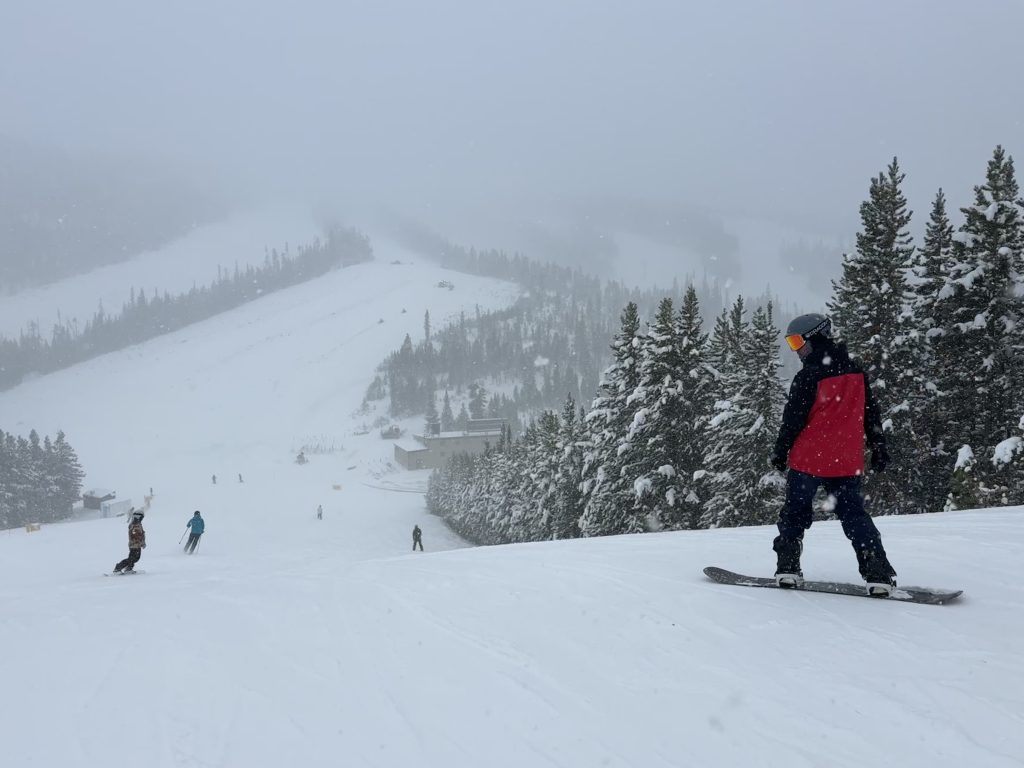
At the heart of the Continental Divide, Grand County’s mountains provide a variety of outdoor opportunities with something for every rider.
Winter Park contains 3,081 rideable acres, 171 trails and 23 lifts, and is Colorado’s longest continually operated resort for skiing and snowboarding.
Its terrain is diverse: Winter Park has multiple distinct zones, such as Parsenn Bowl and Vasquez Ridge, and the separate Mary Jane Mountain for a mix of glades, powder stashes, steep runs and intermediate groomers.
With 6 lifts and 45 trails on its two mountains, Granby Ranch offers a less-crowded atmosphere that welcomes and caters to beginners. Its east mountain contains mostly gentler slopes for cruising, while the west side is intended for intermediate to advanced riders.
At Granby Ranch, all trails loop back to a single base area. With easy logistics and less space to navigate, it’s difficult to get lost or end up separated from your group — convenient for those riding with mixed-skill company.
Both resorts offer group and private ski and snowboarding lessons. Prices vary depending on the participant’s age and length of lesson. For the most detailed information, visit the website of the resort you wish to book your lesson.
For a first-time adult at Granby Ranch, a half-day group lesson is $239 during off-season and $269 during the season’s peak. Private lessons run from $99 to $119 for an hour to the highest tier of $1,249 to $1,349 for a full-day, four-person premium package. Unless you are a season pass holder, you will also pay an additional $45 for a lift ticket. Rentals are included in all lessons.
Group lessons at Winter Park for adults also vary in price by date, but run between $184 to $299 for three hours. Private three-hour lessons are $694 on less busy days, and go up to $879 on peak days. Lesson participants can purchase discounted lift tickets for $94 and beginner rentals for $70 to $79.


Support Local Journalism
Support Local Journalism
The Sky-Hi News strives to deliver powerful stories that spark emotion and focus on the place we live.
Over the past year, contributions from readers like you helped to fund some of our most important reporting, including coverage of the East Troublesome Fire.
If you value local journalism, consider making a contribution to our newsroom in support of the work we do.