Study finds lack of local wildfire mitigation resources in northwestern Colorado, where 4th largest wildfire in state history burned last summer
Colorado State University study identified Rio Blanco, Moffat and Garfield counties as having a high fire risk but lacking local capacity for wildfire mitigation

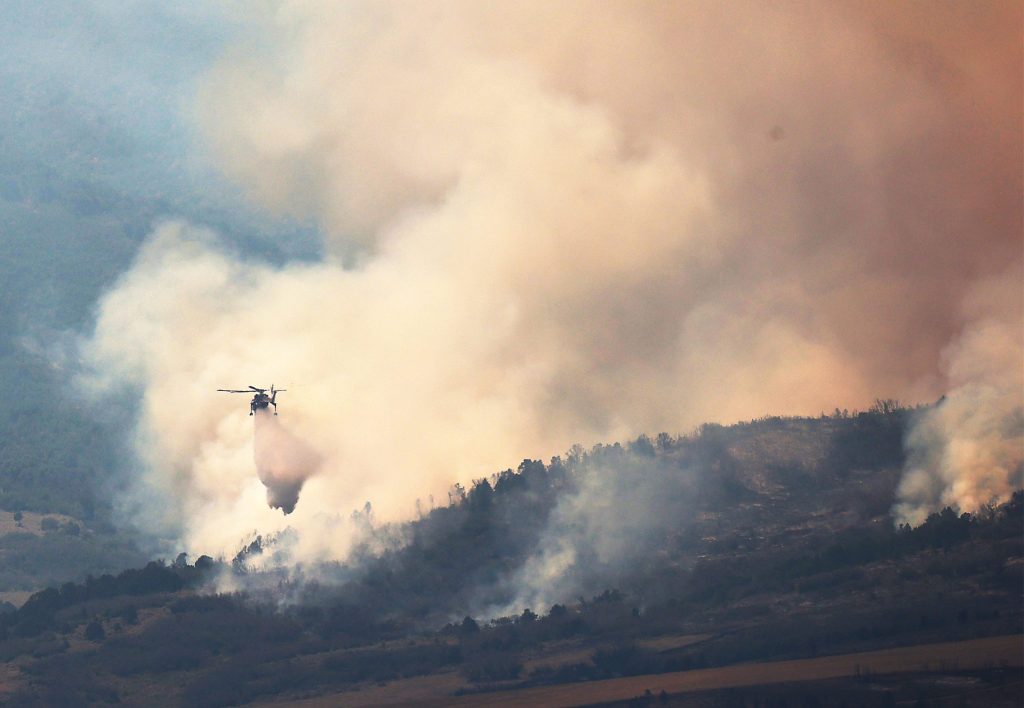
John F. Russell/Steamboat Pilot & Today
A study has found a mismatch between wildfire risk and mitigation resources in Colorado, including a lack of local resources in the northwest, where the fourth largest wildfire in the state’s history burned last summer.
The study by Colorado State University researchers is among the first to map local capacity to reduce wildfire vulnerability, according to a news release. It was published in the peer-reviewed journal Forest Science last year.
“Reducing vulnerability to wildfire requires the engagement of many different actors, including private landowners, local organizations and state and federal management authorities,” Karissa Courtney, the study’s lead author, said in an email. “A lot of resources have been directed toward modeling and mapping wildfire risk, but complementary representations of local capacity have largely been lacking.”
The study overlaid existing models that map wildfire risk in Colorado with a new model mapping local wildfire mitigation capacity across the state to show where wildfire risk is high, but resources are lacking.
The results showed Rio Blanco, Moffat and Garfield counties as among the most at risk for wildfires while having the least local capacity to reduce risk, respond to and recover from wildfires.
Courtney noted that the Lee Fire — the fourth largest wildfire in Colorado’s history — burned last summer in the northwestern corner of the state.
“This study can tell us that many of the resources related to pre-fire forest management work are absent from the northwest region,” she said.
Scientists map local capacity
Researchers defined local capacity as a community’s ability to complete projects, like creating defensible space around homes and neighborhoods, doing prescribed burns and tree thinning, Courtney said.
To generate the model mapping local wildfire mitigation capacity, she said researchers created an index of nine indicators that could be measured across the state using publicly available data.
“A main question to ask is: Is there local capacity in X area to do pre-fire forest management work, or make your property safer if it is threatened by a wildfire?” Courtney said. “… While wildfire response capacity is just as important, that is not the capacity we were mapping.”
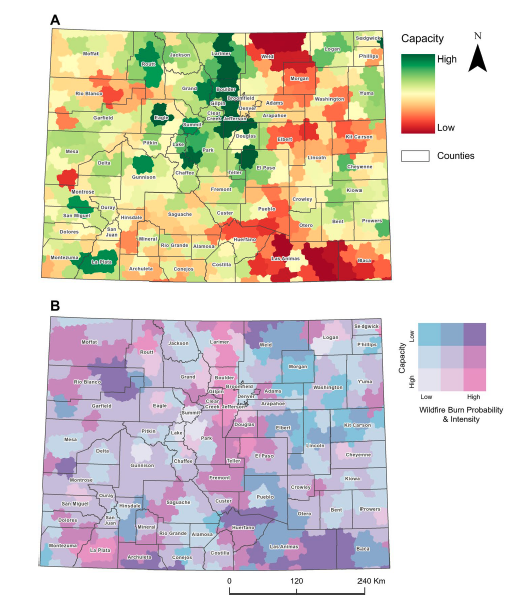
Local capacity indicators included the basic demographic features of an area, like its population and how rural or urban it is, as well as whether an area had completed past wildfire fuels treatment projects or received funding through the Colorado State Forest Service’s Forest Restoration and Mitigation program, according to the study.
Researchers also considered social factors, such as whether there were homeowners associations in the area to help residents access information, whether there were local wildfire-related organizations and whether there were any FireWise USA-certified neighborhoods or fire protection districts.
To determine how much weight to give each variable, the study states that researchers sampled 86 Colorado-based wildfire practitioners, asking them to rate the importance of each indicator for local capacity on a scale from zero, or “not at all important,” to 10, or “extremely important.” An average for each indicator was then calculated.
The researchers weighted state grant funding as the most important and wildfire collaboratives as the second most important. Fire protection districts and community wildfire protection plans were also determined to be important indicators of local capacity. Other local indicators received less weight in the model.
Northwest Colorado lacks wildfire funding, study finds
One major takeaway from the research is that northwestern Colorado communities received little to no funding through the Colorado Forest Restoration and Wildfire Risk Mitigation grant program, Courtney said.
Established in 2017, the grant program provides state support through competitive grants that fund community-level actions aimed at reducing wildfire risk, promoting forest health and encouraging use of woody material, according to the Colorado State Forest Service. About $7 million was available in the past grant cycle.
“We can see the northwest region largely has not received this funding, nor even applied for it,” Courtney said. “This suggests that there is potentially less capacity to write grant proposals, or less interest in the grants themselves.”
This is in stark contrast to the Front Range, where the study found that wildfire risk and wildfire mitigation resources were aligned due to the disproportionate level of funding these communities receive.
While the state grant program helps fund mitigation projects, the researchers raised concerns that the funding may not be being distributed equitably. The state government has recently attempted to address the funding disparity by redirecting a percentage of the funds toward low-resource areas, but the study notes it is too early to assess how successful that effort has been.
Other high-risk but under-resourced communities identified by the study included Huerfano, Archuleta, Conejos, Las Animas and Baca counties in southern Colorado.
“Lower capacity communities need assistance from policymakers and managers,” the study states. “Our index points specifically to under-served areas of the state as being low capacity, including the northwestern and southern regions of Colorado, who often struggle with funding and staff time to complete mitigation work.”
Research shared with Colorado Forest Service, fire practitioners
Courtney said that the results of the study have been shared with the Colorado State Forest Service, which collaborates with the university, and fire practitioners around the state, with the goal of informing policy decisions.
Colorado State Forest Service Monitoring Program Manager Ethan Bucholz said in a statement that the findings of the study could help those who score grant programs to take an applicants’ local capacity into context.
“The most important aspect of Karissa’s research is highlighting areas where capacity is lacking, to give grant applicants from lower-capacity areas data that may increase their likelihood of funding,” Bucholz said.
Based on the results of the study, the researchers suggested increasing funding to support planning, staff training, relationship-building and other activities that are related to wildfire mitigation, rather than just funding for wildfire treatments projects themselves.
Providing grant writing expertise to regions with lower capacity or bridging existing collaborative organizations to bring technical and strategic planning to these areas could also help increase capacity, according to the study.
“Our findings show how a spatially explicit approach to measuring capacity can help prioritize policy decisions at a broader scale and could be used to identify areas to conduct more specific and nuanced qualitative work,” the study states. “Further, our findings highlight that pathways to capacity building are diverse and based on local context and need.”




Support Local Journalism
Support Local Journalism
The Sky-Hi News strives to deliver powerful stories that spark emotion and focus on the place we live.
Over the past year, contributions from readers like you helped to fund some of our most important reporting, including coverage of the East Troublesome Fire.
If you value local journalism, consider making a contribution to our newsroom in support of the work we do.