Winter Park Resort honors its Arapaho heritage with a new art installation around the slopes
A multi-piece art installation, anchored in the Arapaho language, asks skiers and riders to acknowledge the role snow plays in their lives, cultures and ecosystems
The Colorado Sun

Hugh Carey/The Colorado Sun
Connor Ryan has a wish for every skier and rider who comes to Winter Park resort — and it doesn’t involve snow billowing over your head with every turn or a snorkel to survive skiing it.
He wants them to pause, take in their surroundings and let the feelings the snow, the mountains and skiing bring up in them guide them to greater appreciation. The place he wants them to appreciate is the Arapaho National Forest and the Fraser River watershed, both of which cradle the slopes of Winter Park and Mary Jane. And thanks to him, a collective of Indigenous artists, Alterra Mountain Co. and Winter Park, he believes, it’ll now be easier for the consortium interested in honoring Indigenous ancestry to do that.
On Wednesday, he stood in front of Sunspot Lodge at the top of Winter Park next to the centerpiece of a multipart public art installation the creators and supporters of which hope will help connect the “sense of awe, gratitude, appreciation and purpose” people feel when they’re skiing and riding to “the languages and cultures that have been connected to here since time immemorial,” he said. It also highlights “the role snow plays in our lives, cultures and ecosystems,” Winter Park says.
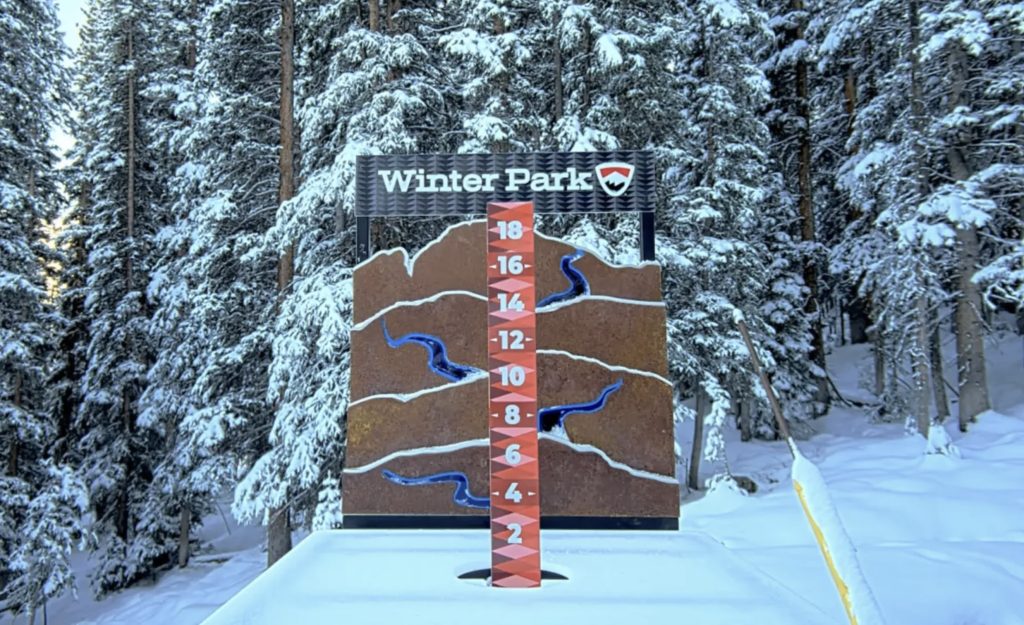
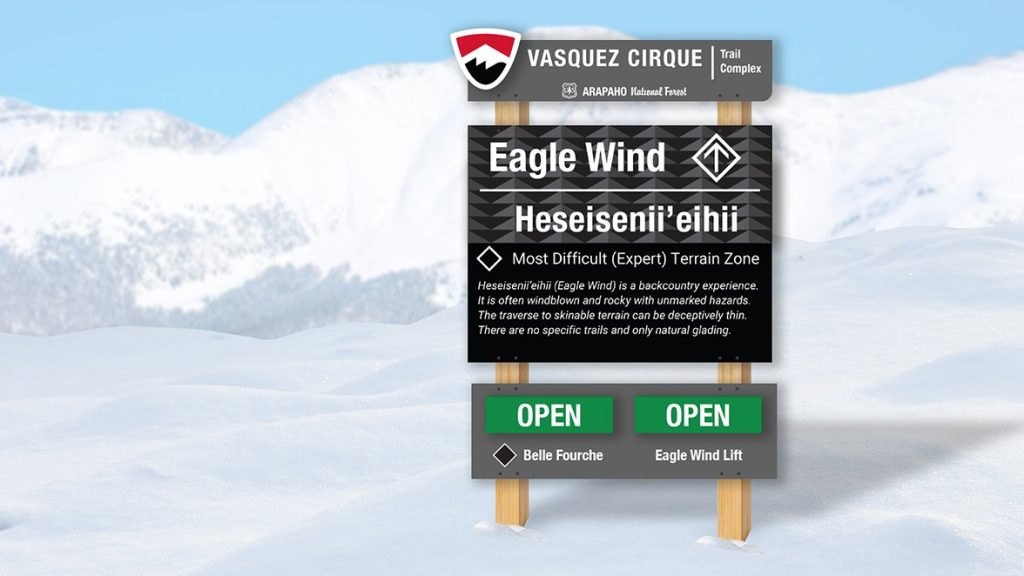
The feeling Ryan wants others to experience has a name in the Arapaho language — heniiniini’ (pronounced hee nee nee neh). Its direct translation is “there is snow on the ground.” The word is emblazoned on the main installation, which features the four most prominent mountains in the area — Blue Sky, Byers, Parry and Longs — and the outline of a river winding out of them that conceptually and in real life will feed a garden bed full of native plants at the bottom of the resort come summer. More nods to the culture are scattered across the mountain, in a snow stake, used to measure snowfall, festooned with an accordion of mountains and a river flowing down, updated Arapaho–named trail signs and the addition of Native and Indigenous perspectives to historical trail markers.
Ryan says the installation is important because “the power of art lives in that space between what we can say with words and what we can feel. So it’s really our hope that you can see the art piece and say, ‘Oh, these are the peaks. This is where I am. And this is the water that connects (us). When you can see that visually, I think it helps to break down the barrier for someone who might not be reached by just talking about it.” He hopes the work will get people asking questions about the place.
Read the full story at ColoradoSun.Com.




Support Local Journalism
Support Local Journalism
The Sky-Hi News strives to deliver powerful stories that spark emotion and focus on the place we live.
Over the past year, contributions from readers like you helped to fund some of our most important reporting, including coverage of the East Troublesome Fire.
If you value local journalism, consider making a contribution to our newsroom in support of the work we do.