Are salmonflies in danger in Colorado?

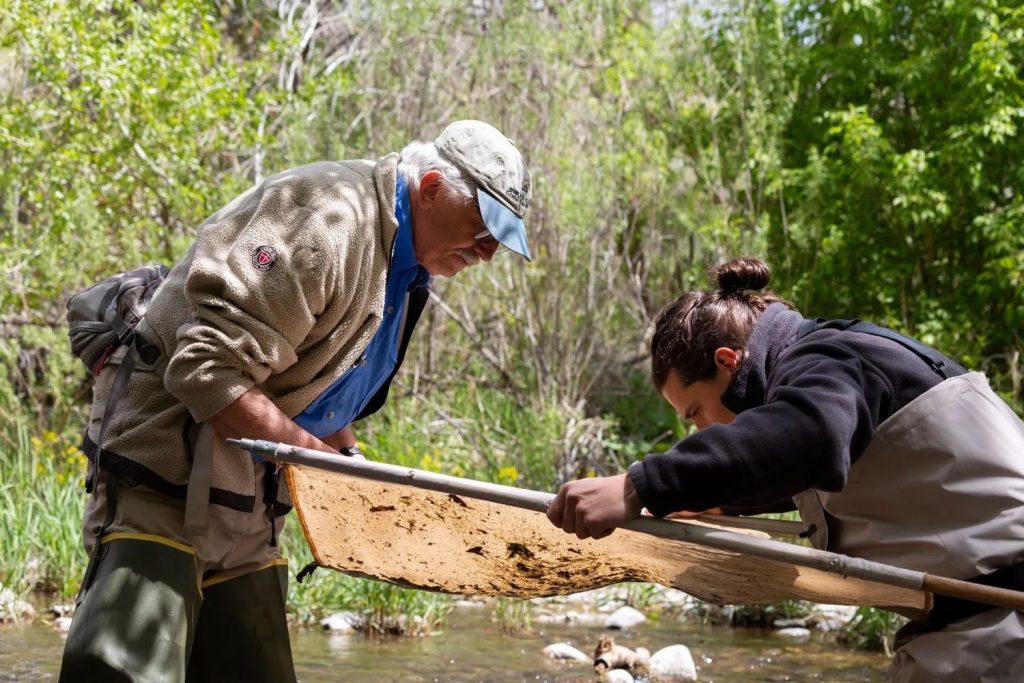
The Salmonfly Project/Courtesy photo
Aquatic insects are unsung heroes in river ecosystems.
Not only do they serve as a nutritional backbone for fish, bats, amphibians and more; they also clean streams by breaking down leaf litter and organic matter cycling nutrients and gauging water quality for fishers and fish alike.
But these great equalizers are under threat. In particular, the salmonfly — named for its salmony-pink color — is facing significant decline in the Rocky Mountain West.
The Salmonfly Project, launched in 2022 in Missoula, Montana, has tracked the decline of the giant salmonfly in Utah, Montana and now Colorado. What they uncovered so far has shocked them.
“In Utah, we looked at all the available data that we could find, and we documented an 84% decline in the giant salmonfly,” said project cofounder James Frakes.
The study in Utah led Frakes, along with his research partner and cofounder, Jackson Birrell, to compare salmonfly populations in neighboring states and dive deeper into the reason behind the insect’s rapid decrease in numbers. They now have 13 monitoring projects across Rocky Mountain states.
Using State Wildlife Action Plans in western states, Frakes and Birrell determined that the salmonfly is under threat not only in Utah, but also in Montana, Colorado and other states.
“We’re relatively sure that there’s between a 64% to 90% decline in salmonflies across the entire state of Montana,” Frakes said, although this report is based on preliminary data subject to change.
Colorado Parks and Wildlife has proactively listed the giant salmonfly as a second-tier species in need of conservation, though more data on the state’s salmonfly population are needed to provide an accurate and complete report.
“Right now, even though they’ve been listed, there’s a significant gap in the understanding of their species range and how they’ve been trending over time,” Frakes said. “And without that important information, it’s really hard to enact actual conservation work. We need to understand where specific populations are threatened.”
To collect this necessary data, the Salmonfly Project will rely on funding and volunteers.
The first step to expanding their work to Colorado, Frakes said, is to build a monitoring network of volunteers to get out in the field in the headwaters of the Colorado River.
“The idea is to go to historical sites that have data and go back and check again and basically get a trend over time,” Frakes said. “And then we’ll integrate all that data into a model and deliver a statewide assessment to Colorado Parks and Wildlife, which they can then use to inform their conservation efforts.”
After all the fieldwork and data collection is said and done, Frakes and his team will work with managers at the local watershed level to figure out restoration pressures. The team also pulls from available insect repository data to figure out which specific waterbody locations are facing the biggest threat to their aquatic insect population. In Colorado, the upper Colorado River is the first priority the team hopes to tackle, Frakes said.
“The Colorado River really is an important refuge for salmonflies in the state,” he said.
In addition to two to six local volunteers, the Salmonfly Project is also requesting $5,000 in funding to sponsor research in the region of the upper Colorado River. Data collection will take about two years, with just two to three days of on-site volunteer work per year.
Through this hands-on work, Frakes hopes the team can come to a consensus about why the salmonfies are disappearing. For now, he said, it remains “a million-dollar question.”
His hunch is that changing water temperatures and flow levels are the driving factors causing the bugs to die out, but by restoring high water levels, there is hope for the salmonfly.
“What I can tell you is, without water in our rivers, you don’t have the habitat for bugs,” Frakes said, noting that one of the main drivers of aquatic insect distributions is temperature, especially during the summer. “If you can increase water availability in the summertime, when it’s the hottest, you can increase suitable habitat.”







Support Local Journalism
Support Local Journalism
The Sky-Hi News strives to deliver powerful stories that spark emotion and focus on the place we live.
Over the past year, contributions from readers like you helped to fund some of our most important reporting, including coverage of the East Troublesome Fire.
If you value local journalism, consider making a contribution to our newsroom in support of the work we do.