Latest economic data shows growth of outdoor recreation economy slowing nationwide — and in Colorado
The outdoor recreation industry saw challenges including tariffs and impacts to public land in 2025, according to industry experts

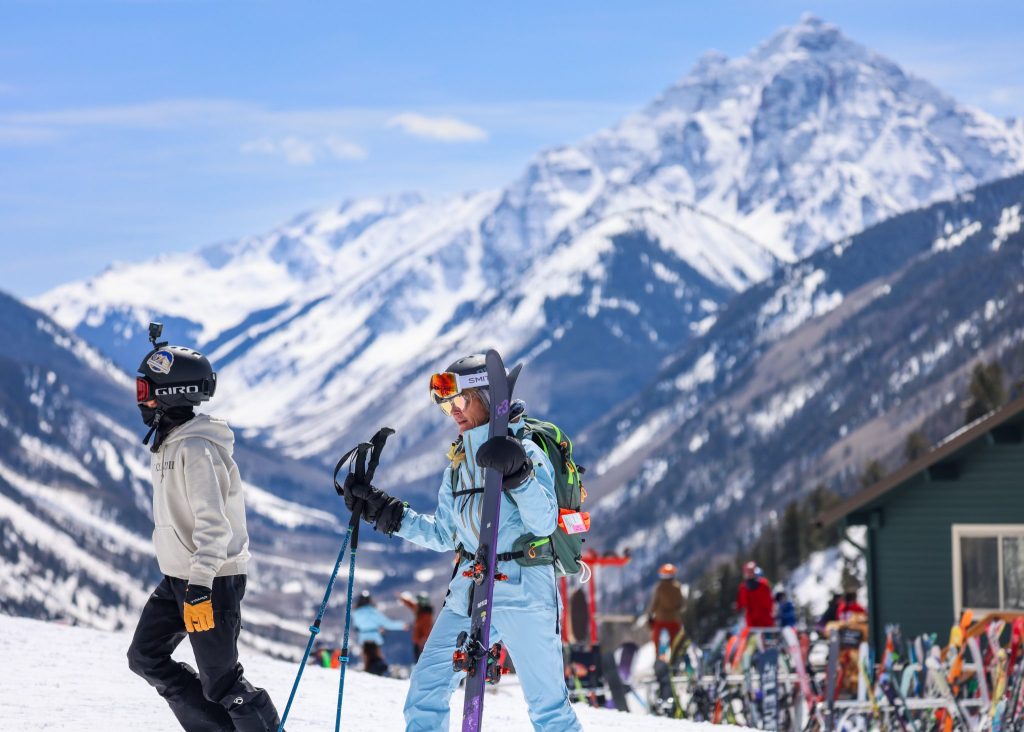
The outdoor recreation industry continued to grow across the country, including Colorado, but slower than in years past, according to economic data published this week by the U.S. Department of Commerce’s Bureau of Economic Analysis.
The outdoor recreation statistics show the industry generated $1.3 trillion in gross economic output across the U.S., created 5.3 million jobs and accounted for about 2.3% of the nation’s gross domestic product in 2025.
“Today, we’re here to share a powerful message: The outdoors is a major economic engine for our country,” said Whitney Potter Schwartz, the interim president of the Outdoor Recreation Roundtable, during a news conference announcing the new data on Wednesday, Nov. 18.
The Outdoor Recreation Roundtable is a national nonprofit coalition of thousands of trade associations, businesses and other organizations that aims to promote the growth of the outdoor recreation economy and outdoor activities.
The outdoor recreation industry — which includes everything from boating and fishing to biking, skiing, camping, hunting, horseback riding, off-roading and much more — added $704 billion in value to the nation’s economy in 2025, according to the federal data. Adjusted for inflation, the industry grew 1.9% year-over-year, reflecting an overall slowdown in growth across the industry, which had grown by about 2.5% in 2024 and 3.6% in 2023.
Outdoor industry growth lagged behind the nation’s economy as a whole, which grew about 2.3% year-over-year in 2025. Since the Bureau of Economic Analysis began collecting outdoor recreation statistics in 2012, the industry has grown more than 40% nationwide, adjusted for inflation.
In the U.S., the top five outdoor recreation activities for economic value added were boating and fishing, which produced $39 billion; recreational vehicle camping, which produced about $27 billion; hunting, shooting and trapping, which produced $15 billion; motorcycling and off-roading, which produced $11 billion; and climbing, hiking and tent camping, which produced about $8.3 billion.
The economic data shows the fastest-growing activities last year included climbing, hiking and tent camping, which grew by 5.6%; amusement parks and water parks, which grew by 4.7%, and recreational flying, which grew by 4.2%.
California, Florida and Texas had the three biggest outdoor recreation economies in 2025, with the industry adding about $88 billion, $67 billion and $60 billion in value, respectively, according to the data. Colorado had the tenth largest outdoor recreation economy, with the industry adding about $18.5 billion in value.
“Today’s data shows the outdoor recreation industry continues to demonstrate consistency and growth as a critical sector of the U.S. economy, despite headwinds from trade, inflation, threats to public land and infrastructure needs,” Schwartz said.
Outdoor recreation is ‘central’ to Colorado’s identity
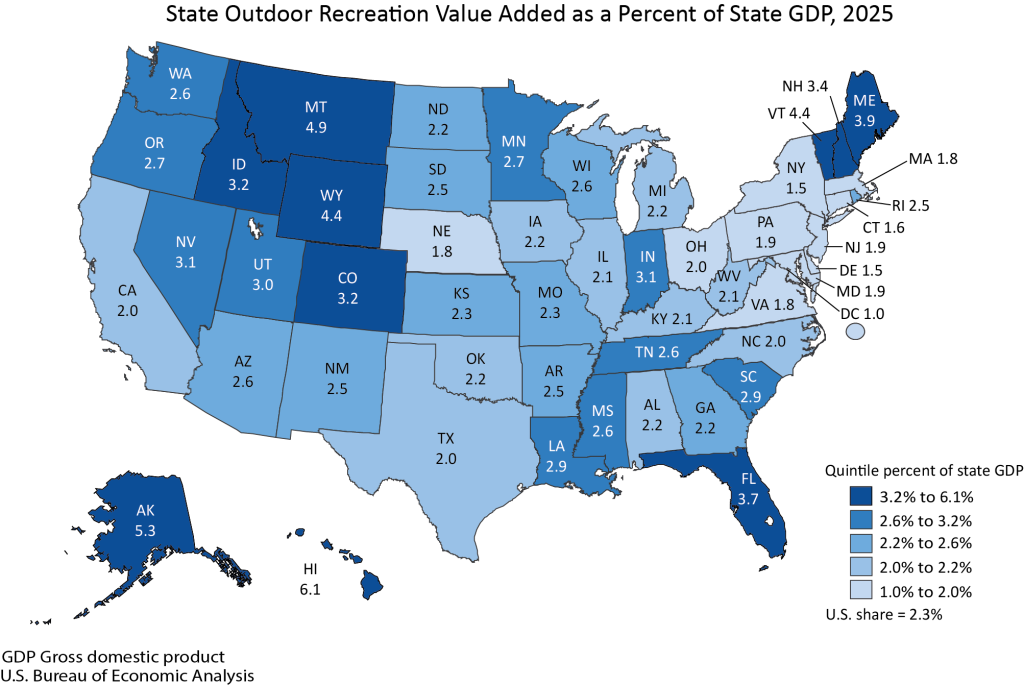
Colorado’s outdoor recreation industry grew slower than the industry as a whole in the U.S. in 2025, though, according to state-level data from the federal government. While the outdoor recreation industry as a whole grew at about 5%, not adjusted for inflation, Colorado’s outdoor economy grew only 4.2% compared to the previous year, the data shows.
The statewide statistics — which were not inflation-adjusted — shows the outdoor industry accounted for about 3.2% of Colorado’s gross domestic product in 2025, produced about 137,415 jobs in the state and provided Colorado workers with $9.6 billion in compensation.
“Outdoor recreation is more than an economic powerhouse in Colorado — it’s central to who we are as a state,” said Conor Hall, Director of Colorado’s Office of Outdoor Recreation Industry, in a statement.
Snow activities like skiing and snowboarding produced more economic output in Colorado than any other state. In Colorado, snow activities accounted for more than $1.75 billion in value added to the economy in 2025, according to the data. That’s more than one-fifth of the economic activity produced by snowsports nationwide last year.
Conventional boating and fishing added about $780 million to the state’s economy and RVing about $562 million, according to the data.
The data shows the outdoor recreation industry provided about 36,700 jobs in retail, 31,500 jobs in arts, entertainment and recreation, and 32,400 jobs in accommodation and food services in Colorado in 2025.
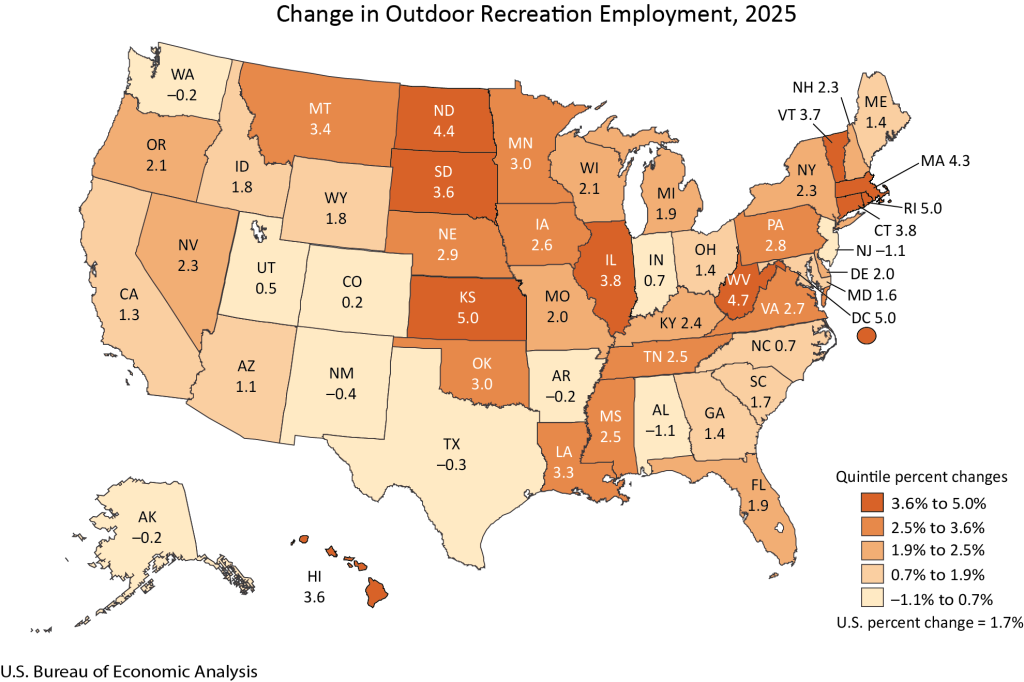
Outdoor recreation employment remained about flat, increasing about 0.2% compared in Colorado to the 1.7% average growth nationwide from 2024 to 2025, according to the data. Compensation in Colorado’s outdoor industry increased 2.6% year-over-year, compared to an increase of 4.6% for the industry nationwide.
Average compensation per job in Colorado outdoor recreation industries was $70,188 in 2025, compared with $100,689 for all salaried jobs in the state, according to the data.
“While these numbers demonstrate the strength of Colorado’s outdoor economy, we also recognize the challenges facing our businesses, from slowing growth and shifting consumer spending to rising costs and uncertainty around tariffs,” Hall said. “That’s why it’s more important than ever to continue investing in Colorado’s outdoor industry — supporting businesses and entrepreneurs, developing our workforce, expanding recreation opportunities, and protecting the public lands and natural resources that underpin this economy.”
Tariffs and public land threats raise concern
The outdoor recreation economies in the U.S., and Colorado, continued to grow despite challenges. The industry saw growth explode as a result of the 2020 pandemic, but it has continued to slow since.
In 2025, the industry grappled with uncertainty from tariffs instituted by President Trump’s administration. For the outdoor industry, Schwartz said trade stability is important because products from tents and footwear to bikes, fishing equipment and ski gear depend on global supply chains.
“Year-over-year growth is slower than in past years, which reflects the need for more policy attention and investment,” she said.
Public lands — which generate $351 million in economic activity every day, according to an analysis by the Outdoor Recreation Roundtable — also faced challenges in 2025. In the first days of Trump’s second term, the Department of Government Efficiency slashed tens of thousands of jobs across the federal government, including at land management agencies like the U.S. Forest Service, Bureau of Land Management and National Park Service.
Colorado ski resorts, nearly all of which operate on federal land, reportedly experienced a slow-down in permitting as a result of the federal cuts and other outdoor recreation businesses also felt the effects of fewer federal workers.
These challenges continued into 2026 — which also saw one of the worst winter ski seasons in the West — as the Forest Service announced a massive reorganization and the U.S. Department of Interior launched plans to sell off public lands.
“We need to recognize outdoor recreation as essential infrastructure for public health and community well-being and preserve access to public lands and waters as a high-return national investment,” Schwartz said. “This means opposing the large-scale transfer or sale of public lands and waters.”
Moving forward, she urged Congress to pass the America the Beautiful Act, a bipartisan bill that would reauthorize the National Parks and Public Land Legacy Restoration Fund to provide funding to address backlogs across national parks and public lands. She said the federal government should also continue working to fully implement the Expanding Public Lands Outdoor Recreation Experiences Act. Known as the EXPLORE Act, this law passed by Congress in 2024 focused on increasing outdoor recreation opportunities, modernizing infrastructure and improving access.
She concluded, “Our public lands are uniquely American and are the foundation of the outdoor recreation economy, fueling businesses in communities large and small, rural and urban, in every corner of the country.”




Support Local Journalism
Support Local Journalism
The Sky-Hi News strives to deliver powerful stories that spark emotion and focus on the place we live.
Over the past year, contributions from readers like you helped to fund some of our most important reporting, including coverage of the East Troublesome Fire.
If you value local journalism, consider making a contribution to our newsroom in support of the work we do.