Snow falling in the Colorado Rocky Mountains prompts backcountry officials to warn that avalanche season is here
Backcountry users in the High Country should be aware that ‘If there is enough snow to ride there, there is enough snow to slide'
Summit Daily

Colorado Avalanche Information Center/Courtesy photo
- Navigation — Map, compass and GPS system
- Signaling — Whistle, mirror, cell phone, surveyor tape
- Light source (two) — Headlamp, flashlight, extra batteries
- Nourishment — Water and high-energy food
- Shelter — Lightweight waterproof tarp, bivvy sack, parachute cord
- Fire building — Matches, fire starter, heat tabs, knife, saw
- Personal protection — Medications, first-aid kit, sunscreen, dark glasses, bug repellent
- Weather protection — Extra clothes, rain gear, hat, gloves, heavy duty plastic bag
- Winter add-ons — Beacon, probe, shovel
- Rules to always follow — Never go alone, tell someone where you’re going and when you expect to return, stay on the trail, stay where you are when waiting for rescue, know how to use equipment
Winter has arrived, and with the fresh snowfall many Coloradans are dusting off their skis and snowboards to head out into the Rocky Mountain backcountry as resorts begin to open for the season.
But with snow comes the possibility of avalanches. Several avalanches have already been reported in Colorado this season, and backcountry users need to be prepared for the range of conditions present in the mountains this time of year, Colorado Avalanche Information Center Director Ethan Greene said.
“We’re at that point where the places you can make turns are also the places that are dangerous,” Greene said. “We have snow on the ground, so this is avalanche season. The stuff you do mid-winter is the stuff you should start doing now.”
Last season, more than 5,800 avalanches were reported to the Colorado Avalanche Information Center, according to a 2022-23 season summary. The state reported 11 avalanche deaths during the season, four more than the annual average over the past 10 years, according to the summary.
Summit County Rescue Group member Anna DeBattiste noted that those planning to head out into the backcountry should educate themselves about the existing conditions and carry the proper gear.
“We really hope for a less tragic season,” DeBattiste said.
Anyone headed out into the Colorado backcountry should carry an avalanche transceiver, probe and shovel as well as a buddy who is carrying the same gear and knows how to use it, DeBattiste said.
Greene said the Colorado Avalanche Information Center began publishing its daily avalanche forecasts this week, so those headed out into the backcountry should check those forecasts to assess the conditions before heading out. Those who plan to spend a lot of time in avalanche terrain this winter should also consider taking an avalanche class with a field component, he added.
“It’s really beautiful out in the mountains right now,” Greene said. “We’ve got a lot of fresh snow. The snowpack is kind of shallow with a lot of obstacles underneath that snow. Anytime we’ve got snow on top of a steep slope, there is a chance for an avalanche, so go out with your avalanche eyeballs on.”
Last year, a skier triggered and was caught in an avalanche near Ashcroft on Oct. 27. So while it is early in the season, the avalanche danger this time of year is not something to be underestimated, Greene said.
From an avalanche perspective, hillsides with slopes under 30 degrees are the safest places to recreate, Greene said. While places with deeper snow may be more appealing for making turns, these slopes are also probably more dangerous, especially where fresh snow has fallen on older snow, he added.
So far this season, the most dangerous avalanche conditions in Colorado have been present in the west-central mountains from the West Elk Mountains up through the Sawatch Range through Aspen and into Crested Butte, Greene said. He noted that on many of these peaks, last week’s storm dropped a layer of fresh snow atop older snow.
“Every weather event throughout the winter creates a layer in the snowpack,” Greene said. “Snowstorms, windstorms, sunny days — all those create a layer. Avalanche danger is going to be highest when we have really big differences between those layers.”
Summit County Rescue Group member Aaron Parmet is an avalanche rescue technician with the Colorado Rapid Avalanche Deployment and the lead avalanche faculty member for Colorado Mountain College’s Breckenridge campus.
Over his decades in Summit County, Parmet said he was “absolutely that guy who was up on the pass when the first storm came in,” so he approaches avalanche safety as someone who loves to recreate in the backcountry.
“Just because the snowpack is thin doesn’t mean the avalanche danger isn’t there,” Parmet said. “There are smaller avalanches early in the season, but the consequences can be magnified by the fact that the snowpack is really thin.”
Less snow may mean a skier or splitboarder is less likely to be buried in an avalanche, Parmet said, but it also means that there are more obstacles — from exposed rocks to roots just under the surface of the snow.
A lot of the slides early in the season won’t break at a weak layer in the snow but will actually slide right over the ground, Parmet said. That means that someone caught in the avalanche is more likely to “ground up” when they are pulled into rocks and stumps that are not yet buried under the snow, he said.
“Think very carefully, when you decide to ski a line, about what is underneath the snow,” Parmet said. “That is besides avalanche danger. If you put a tip under a log on your way down and break your leg, your season is done before it even started.”
Backcountry users should also be aware that the early winter conditions can increase the time it takes to evacuate an injured party, Parmet said. Compared to bare ground in the summer, snow and ice is more difficult for rescuers to move over, but there is also not enough snow this time of year to ski a toboggan in, he said.
The variation between snow cover, ice and rocks means backcountry users should also be prepared to travel by different modes, Parmet said. While there may be areas where skiers can skin up the mountain, there are also likely areas of bare or ice-covered rock that may require microspikes or crampons, he said.
Temperatures too can be highly variable this time of year, meaning that backcountry users need to carry clothing appropriate for anything from late summer conditions to below-zero temperatures, Parmet noted.
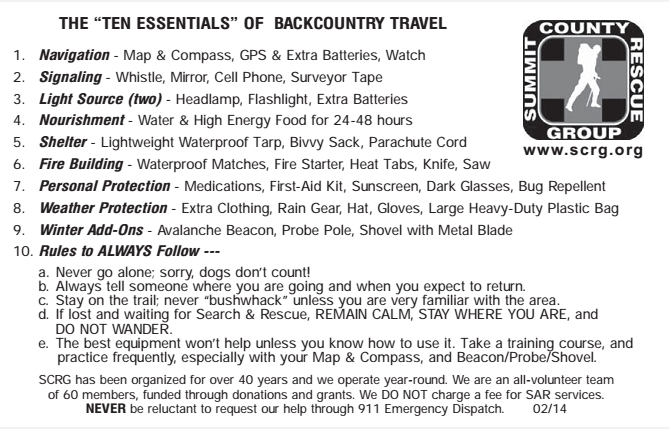
Anytime someone is headed out into the Colorado backcountry, they should carry the 10 essentials and leave a trip plan with someone back home that includes a time when people can expect them back, DeBattiste added.
“We want people to keep in mind ‘If there is enough snow to ride there, there is enough snow to slide,'” DeBattiste said. “So if they’re getting out there they should be getting their avalanche equipment out and ready to go and reading the forecast and being prepared.”


Support Local Journalism
Support Local Journalism
The Sky-Hi News strives to deliver powerful stories that spark emotion and focus on the place we live.
Over the past year, contributions from readers like you helped to fund some of our most important reporting, including coverage of the East Troublesome Fire.
If you value local journalism, consider making a contribution to our newsroom in support of the work we do.