Colorado wildfire leaders warn of ‘very challenging fire year’ amid widespread drought
Federal wildfire officials, including at the new U.S. Wildland Fire Service and the Forest Service, also affirmed their readiness

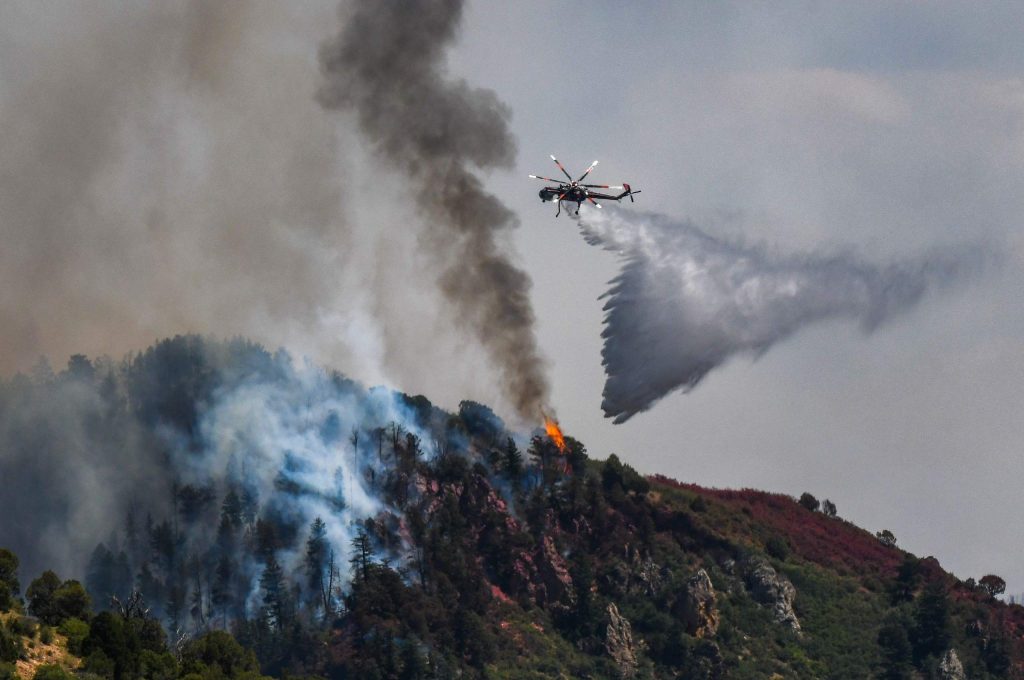
Post Independent file photo
Colorado wildfire leaders are bracing for what could be an especially busy and dangerous summer for wildfires across the West.
The Colorado Division of Fire Prevention and Control presented its wildfire preparedness plan to Gov. Jared Polis on Thursday, April 30, during a news conference where state and federal partners affirmed their readiness to respond and called on the public to prepare.
“We are facing a very challenging fire year, where our resources will be tested across not only Colorado, but across the West,” said Colorado Division of Fire Prevention and Control Michael Morgan during the briefing at the division’s hangar in Broomfield.
Colorado — and most of the West — is heading into summer after some of the worst winter snowpack conditions on record and persisting widespread drought. The latest U.S. Drought Monitor Report shows that 100% of Colorado and roughly 70% of the West are facing some level of drought.
“We’ve had what I’ll call a dismal snowpack year where we anticipate about 95% of the state being in some level of drought for the months of June and July,” Morgan said. “Most of these areas are extremely challenged. We haven’t had enough rain and we haven’t had enough snow, and it’s going to be a challenging year for us.”
While Colorado will face an elevated threat of wildfires this summer, Polis said the state is also more prepared than it has ever been to respond to major wildfires. He said that the state has built out its wildfire response capabilities over the past decade, including purchasing its own multi-mission aircraft, and also putting more resources toward mitigation.
Polis added that Colorado has experienced some of the worst wildfires in its history within the past decade, including the Marshal Fire that destroyed more than 1,000 homes in 2020. The Lee Fire that burned in northwestern Colorado last summer was also the fifth largest in the state’s history.
“While we’re more ready than ever before for what might be thrown at us, we know that there’s an elevated risk of major events this coming summer,” Polis said. “Our swift coordinated response is a result of years of investment.”
Coloradans, especially on the Western Slope, need to prepare
Morgan said northwestern Colorado is experiencing some of the worst drought conditions in the West. Nearly all of Summit, Grand, Lake, Pitkin, Eagle, Routt and Jackson counties remain under exceptional drought, the highest level, according to the U.S. Drought Monitor.
The National Interagency Fire Center’s Significant Wildland Fire Potential Outlook shows above normal wildfire risk across Colorado’s Western Slope during June and July, when much of Arizona, New Mexico, Nevada, Utah, Washington, Oregon and California will also be facing heightened risk.
Colorado Department of Public Safety Executive Director Stan Hilkey warned that, although the state is well prepared for the fire risk this summer, with the dry conditions statewide “there will be big fires.”
Hilkey said members of the public need to do their part and be prepared. He said that includes everything from recreating responsibly, following fire restrictions and ensuring campfires are fully out to doing home ignition zone mitigation work and having an evacuation plan.
“Public safety is not achieved in a vacuum,” Hilkey said. “We have to continue to do this with our partners and our federal partners. One thing that I want to emphasize as well is that the public is the biggest partner in this.”
Morgan said that Colorado firefighters plan to respond to any ignitions this summer with a “rapid, aggressive initial attack to keep fires from getting established.” While firefighters will sometimes allow a wildfire that isn’t threatening structures to burn under close supervision in order to help reduce fuel loads, he said there are no plans to do that this year.
“We know fire is one of the tools that helps us get out of the dilemma we’re in,” Morgan said. “But when we have conditions like we do this year, there will not be, that we can see in the foreseeable future, fires that we’re managing for resource benefit.”
Federal wildfire officials pledge support
Amid major changes to federal land management agencies, including the creation of a new U.S. Wildland Fire Service and a reorganization of the U.S. Forest Service, federal wildfire officials affirmed that their crews are also ready to respond this season.
Paul Hohn, the area fire chief for the federal Wildland Fire Service, explained that the new agency combines wildfire forces from across the Interior Department, including from the Bureau of Land Management, the U.S. Fish and Wildlife Service and the Bureau of Indian Affairs.
Hohn said that while federal agencies underwent a series of staffing cuts and early retirement programs, those programs did not apply to firefighters. The Interior Department has the same amount of staffing as years past, he said.
President Donald Trump’s administration has cut thousands of employees across the federal government over the past year, including thousands at the Forest Service and Bureau of Land Management.
While fire personnel were exempted from these cuts, the federal government lost hundreds of employees with Incident Qualification Cards — or “red cards” — certifying them to participate in wildfire response, even if it isn’t their main job. Federal agencies have to ask some red-carded employees to come back.
The Forest Service is also undergoing a major restructuring as it moves its headquarters from Washington, D.C., to Salt Lake City, Utah. Trump administration officials have said that the reorganization will not impact the Forest Service’s wildfire response, but some former agency employees have questioned that.
Allison Richards, the area fire director for the Forest Service’s Rocky Mountain Region, said on Thursday that the agency is “poised to have the same resources we had last year.”
“We’re doing everything we can to get folks red-card qualified across the entire spectrum, from operations to incident support,” Richards said. “So we are doing everything that we can to be poised here at the regional level as well as nationally.”
Colorado also heads into this fire season without certainty that the federal government will respond to its requests for disaster recovery funds. In the last year, the Trump administration denied two of the state’s requests for major disaster declarations from the president, including for the historic Lee and Elk fires that burned last summer.
Polis said that a lack of disaster declarations — which unlock Federal Emergency Management Agency funds for disaster recovery — wouldn’t impact the state’s wildfire suppression, but could impact recovery.
“It makes the recovery a lot harder, more difficult and slower for the communities that are directly affected by fires,” he said. “We are always going to step up and do what we need to do to protect people’s properties and lives, and we hope that that federal partnership comes back.”



Support Local Journalism
Support Local Journalism
The Sky-Hi News strives to deliver powerful stories that spark emotion and focus on the place we live.
Over the past year, contributions from readers like you helped to fund some of our most important reporting, including coverage of the East Troublesome Fire.
If you value local journalism, consider making a contribution to our newsroom in support of the work we do.