Newsome challenges Linke’s election record as Grand County candidates discuss growth, Flock cameras
Ballot security and voting equipment took center stage at the Sept. 17 Grand County Election Forum, while District 3 commissioner candidates tackled housing, development and automated license plate readers.

Isabel Del Mastro/Sky-Hi News
Grand County clerk and recorder candidate Liz Newsom criticized incumbent Jolene Linke’s election administration during a Sept. 17 candidate forum, citing past election errors and questioning decisions made by the clerk’s office under Linke’s leadership.
“I’m running for this office because I share the concerns of many Grand County residents that our current clerk and recorder has not been meeting that standard for competency and efficiency that voters expect,” Newsom said in her opening statement.
At the Sept. 17, 2026, KFFR County Election Forum, District 3 county commissioner candidates and clerk and recorder candidates answered questions about a variety of Grand County concerns, from election security to balancing countywide growth with wildfire mitigation and water resources.
Republican incumbent Jolene Linke is running for reelection against Grand County Democratic Party Chair Liz Newsom. Randy George is running for reelection against unaffiliated candidate Jeremy Krones.
KFFR and Fraser Valley Community Media solicited questions from residents and consolidated them for neutrality, clarity and time constraints, according to Director Ryan Wilson. Questions were sent to candidates in advance, and candidates prepared answers to present at the forum.
Candidates were given 90 seconds to answer each question, and formal rebuttals were not allowed.
Wilson asked clerk and recorder candidates about maintaining election security, upgrading voting equipment and handling office responsibilities professionally.
When asked what safeguards the clerk’s office should use to ensure ballots remain anonymous and secure throughout the election process, Newsom said the office’s actions during the 2026 primary under Linke were “detrimental” to democracy.
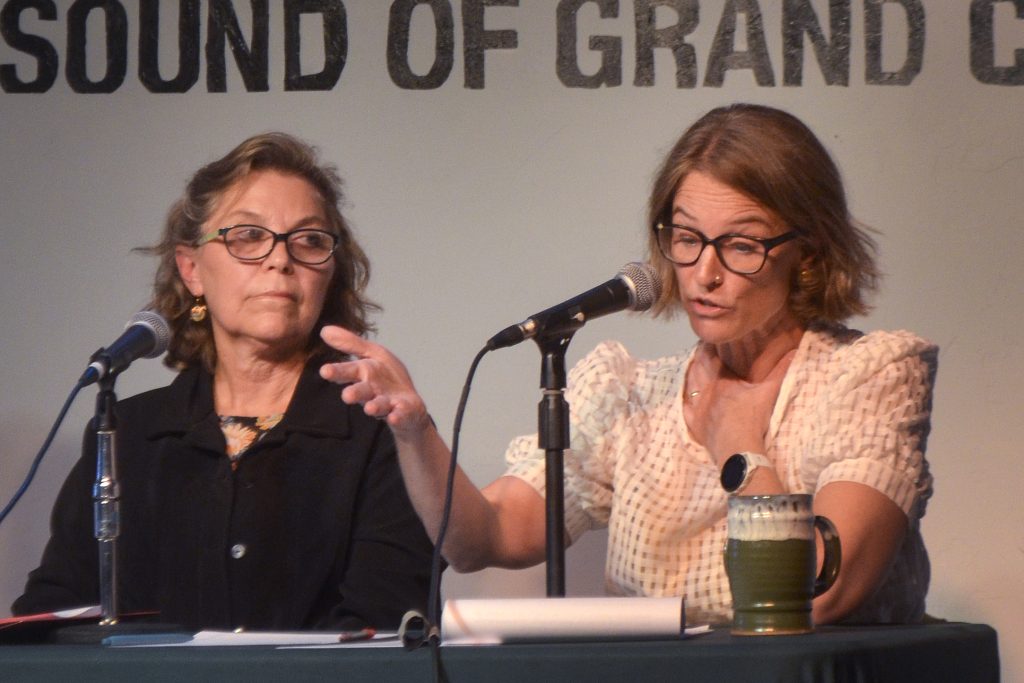
“It’s not clear if it was a misunderstanding of the law, a huge oversight or disregard for the law,” she said. “This is part of a much larger pattern of incompetence,” she added later.
In May, Grand County Democratic Party representative Curtis Brown raised concerns about ballot anonymity after sequences of numbers were printed directly on certain ballots at the county clerk’s office under Linke’s administration, according to an August report by Sky-Hi News.
According to Brown, the numbers were linked to voter registration numbers and potentially de-anonymized certain ballots, a violation of Section 8 of Article VII of the Colorado Constitution, and the county clerk’s office reported the numbers to the secretary of state.
For the upcoming general election, Linke said the office contracted with a professional vendor to complete ballot printing and mailing, and cross-training initiatives were underway to prevent any operational disruptions.
“Improving ballot processing procedures with expert support remains a critical operational priority,” Linke said.
Newsom also criticized the clerk’s office’s decision to replace Dominion voting equipment with Clear Ballot, saying the decision was motivated by a “partisan conspiracy theory.”
“Following through with that promise, she legitimized dangerous political theater and signaled to voters that there had been something distrustful about our previous equipment still used by 60 of 64 counties, sowing seeds of doubt in our election process,” she said.
Linke said the previous Dominion contract expired in 2025, and the decision to switch to Clear Ballot was primarily based on equipment “user-friendliness.”
In her closing statement, Newsom said that her criticism came from “a desire to make life better and easier for the people of Grand County.”
“My goal [is] to ensure that every resident who walks into our DMV, requests a public record, or casts a ballot receives excellent, reliable service,” she said.
Linke said changes proposed by Newsom are easier said than done.
“I don’t think (Newsom) knows how hard this is. We have a budget. We have staff requirements. We can’t hire everyone that she thinks she can,” Linke said.

District 3 candidates address development, Flock cameras, and taxpayer spending
From housing and highway congestion to the use of Flock cameras, pressures associated with Grand County’s growth dominated the District 3 commissioner discussion at a Sept. 17 candidate forum, where Jeremy Krones and Randy George offered voters different approaches to managing the county’s future.
When asked how the county should balance growth with water-resource protection, wildfire risk reduction and infrastructure needs, Krones and George both supported concentrating development in areas with existing infrastructure.
George said that the county needs to concentrate on development where community water and wastewater systems already exist. He also said that private property rights should be protected so that property owners have reasonable opportunities to develop their land without placing undue pressure on “other people and preclude them from developing their areas.”
“There’s good growth, and there’s unacceptable growth,” George said. “Let’s face it. The county’s only involved in the growth that exists outside of the municipalities, outside of the towns of Winter Park and Fraser and Grand Lake and Granby.”
He also said county leaders need to address the maintenance of U.S. Highway 40 and U.S. Highway 34.
Krones said he supported concentrating greater density in places that already have infrastructure, but added that the most “impactful way” to responsibly address growth is to update land-use and zoning codes to prioritize viewsheds, open spaces and working lands.
Allowing additional housing types could lower housing costs while reducing sprawl and pressure on infrastructure, he added.
“We do need more housing, but not everybody wants their own acre and single-family home,” he said.
But when it came to questions about Flock safety automated license plate readers, candidates offered different approaches.
George said the cameras have been “abused.” Instead, they should only collect license plate information and that the data should be deleted within seven days, he said.

Access to that information should be restricted to legitimate law enforcement purposes, and unauthorized access should be “investigated” and “prosecuted” when necessary.
“Otherwise, they must be torn down,” George said.
Krones said he opposes mass-surveillance technology such as automated license plate readers. He questioned whether the public safety benefits justify privacy implications and taxpayer expense.
“This raises serious privacy concerns about how much power our government should have over our daily lives and how much of that power they hand over to private interests,” he said.
He added that when the Flock camera contract comes up for review in the coming months, he wants to see how effective the cameras have been at “catching criminals,” noting that he would want to see the rate of “false leads, mistaken identities and even crimes that the cameras failed to stop.”
The candidates also differed over the county’s decision to commit $5,000, pending legal review, toward an amicus brief in litigation involving Suncor Energy (U.S.A.) Inc. v. County Commissioners of Boulder County.
George defended the county’s participation, pointing out other instances in which Grand County has participated in similar legal or regulatory matters.
Krones opposed the expenditure, saying the litigation did not directly affect county operations and criticizing the limited public discussion that preceded the decision.
“This court case does not affect Grand County operations directly. Instead, it serves to protect large corporate interests and maintain the status quo,” he said.
In future situations similar to this case, Krones said he would have held a public hearing and explained the issue in “simple language” before committing taxpayer dollars.






Support Local Journalism
Support Local Journalism
The Sky-Hi News strives to deliver powerful stories that spark emotion and focus on the place we live.
Over the past year, contributions from readers like you helped to fund some of our most important reporting, including coverage of the East Troublesome Fire.
If you value local journalism, consider making a contribution to our newsroom in support of the work we do.