Staying in Grand: Experts highlight unique challenges facing older adults in mountain towns
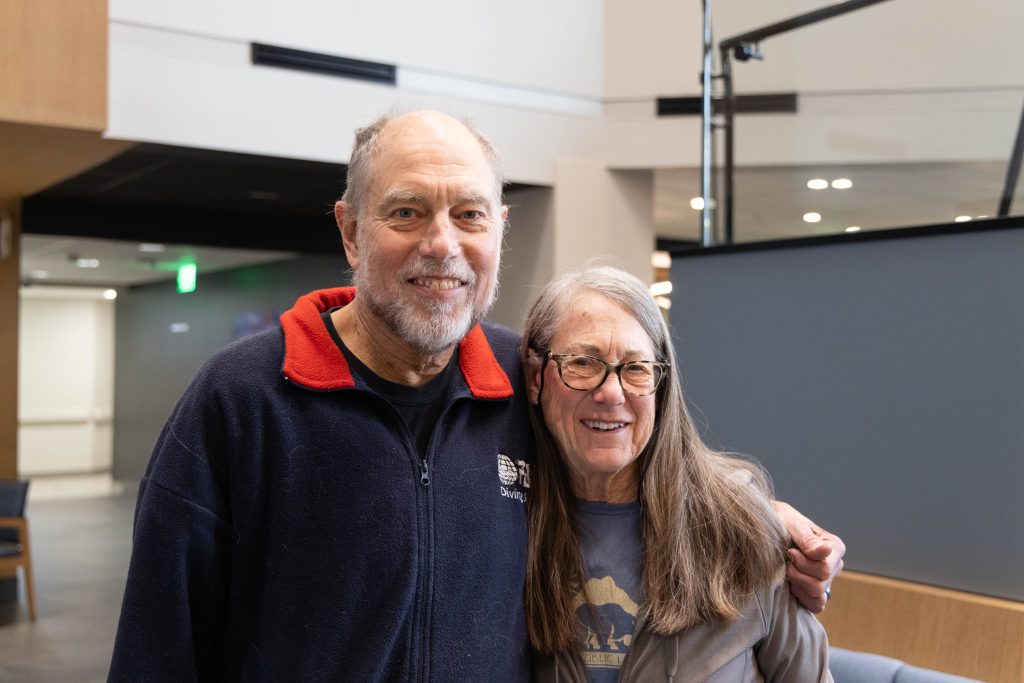
Diana Lynn Rau/Courtesy photo
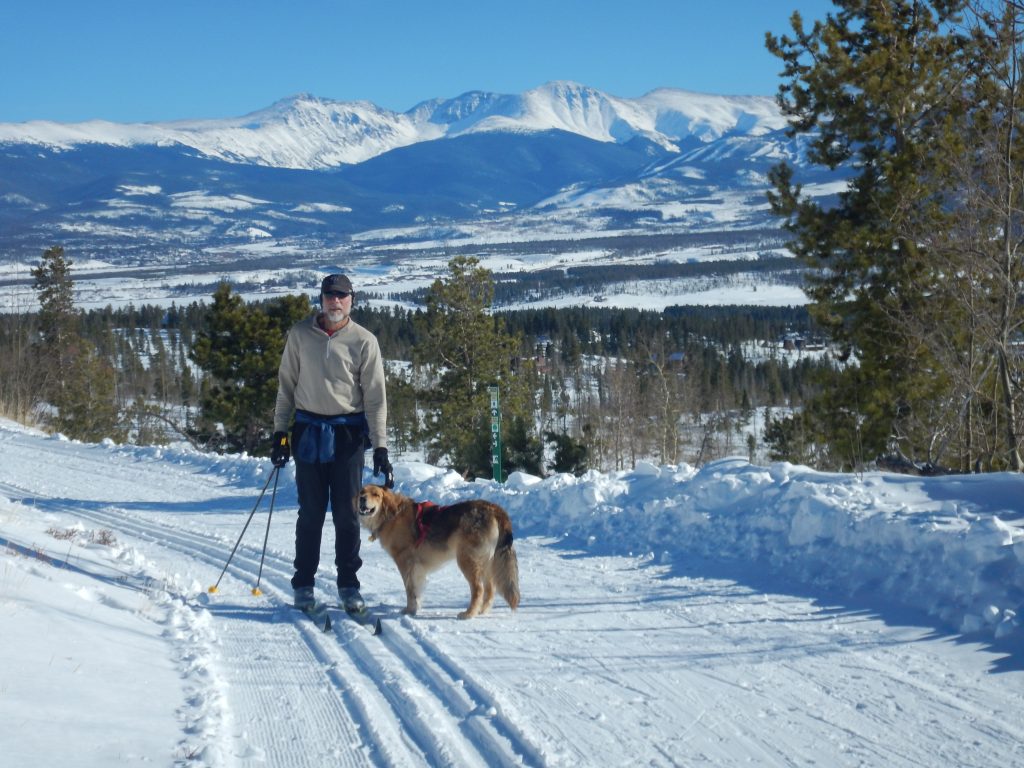
For over 20 years, much of Diana Rau’s time has centered around a quintessential Colorado pastime: skiing. The 77-year-old Nordic club president spends her days on the snow, helping the community enjoy the sweeping views of the mountains surrounding Middle Park.
Like many in Colorado’s mountains, Rau has dealt with sickness over the years, but one recent incident changed her and her husband’s life in a way it never had before.
As people age in rural resort communities like those in Grand and Summit counties, they often face situations that require them to leave for short or extended periods of time — sometimes even permanently. A lack of comprehensive medical services, high costs of living, the effects of high altitude on the body, the inherent risks of an active mountain lifestyle and more add complications for people hoping to age in place in mountain towns. However, individuals determined to remain in their communities have figured out ways to overcome those challenges by learning about, preparing for and engaging with the topic of aging.
“There’s been a lot of people that had to go to Denver for specialty doctors, but they’ve still been able to live here,” Charlie Rau, Diana’s husband, said. “Occasionally, there’s some older people who break down and go. A lot of the older retirees, some of them moved away.”
While helping put on a race at YMCA of the Rockies outside Granby, Diana and Charlie fell ill for around six weeks. Charlie developed pneumonia, and while he received treatment, the doctor noticed his red blood cell count was low. He needed to see a specialist, his doctor said in February.
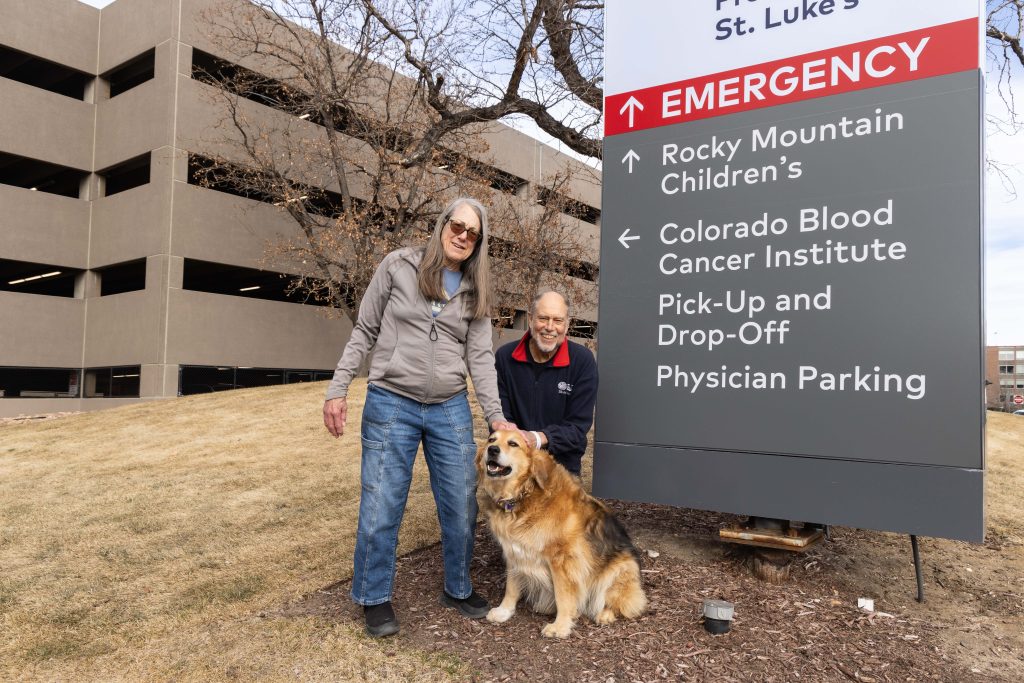
It took until late-spring for Charlie to see a hematologist at the Colorado Blood Cancer Institute in Denver, where blood tests confirmed he had an acute form of blood cancer.
Charlie’s condition has required the couple to drive to Denver for major treatments. He said doctors told him a treatment plan would include months of “severe chemo,” a bone marrow transplant, several weeks in the hospital and having to live close to the hospital for three to four months.
Though mountainous counties have some of the highest life expectancies in Colorado — with Summit ranking No. 1, Pitkin No. 2, Eagle No. 3, San Miguel No. 4 and Grand No. 5, according to data published in 2025 by the University of Wisconsin Population Health Institute — residents have to strategize to overcome challenges unique to resort areas. Throughout Grand and Summit, organizations exist to help older adults do just that.
Community connections remain key
Aging adults facing the possibility of having to move away are often apprehensive about the idea because they do not want to leave their community. Jason Cleckler, the CEO of Middle Park Health in Grand County, said staying socially connected is “really important” for people’s mental health.
“We do live in a mostly rural community,” Cleckler said. “Isolation can be a real challenge.”
What: The Longevity Project
When: Doors at 5:30 p.m., event from 6-7:30 p.m. Tuesday, March 31
Where: Elk Ridge Ballroom at Sun Outdoors Rocky Mountains, 1051 Summit Trail, Granby
Cost: free
The evening will kick off with a welcome reception, including information from our sponsors related to aging in Grand County. The event will then feature a panel discussion on the topic with local and regional experts followed by an audience Q&A.
Guy Gadomski — the treasurer of Staying in Summit, a nonprofit focused on helping mountain residents age in place — said that when aging adults have to leave their communities, it means more than just leaving their friends.
“Every time that a senior has to move and uproot, their health goes down,” Gadomski said. “It’s cruel and unusual punishment.”
Dr. Maximiliano Smolkin, a high-altitude specialist at CommonSpirit St. Anthony in Frisco, said doctors in Summit County try to avoid telling patients they must move to lower elevations because of the impact leaving their community can have.
“Taking away the support of family and friends from someone at that advanced age, it’s going to affect a lot of other medical issues,” Smolkin said.
Smolkin said community plays a large role in mental health and quality of life. An 80-year-old who has lived in a mountain community for a long time and is told by a doctor they need to move into a nursing home in Denver is likely to say they would rather stay in their community, he said, even if it means dying sooner.
“I hear this all the time: ‘Doctor, I don’t care if I die,'” Smolkin said. “‘I want to die here with my friends and family. I don’t want to be alone in a lower (elevation) place.'”
Growing senior population adds demand for resources
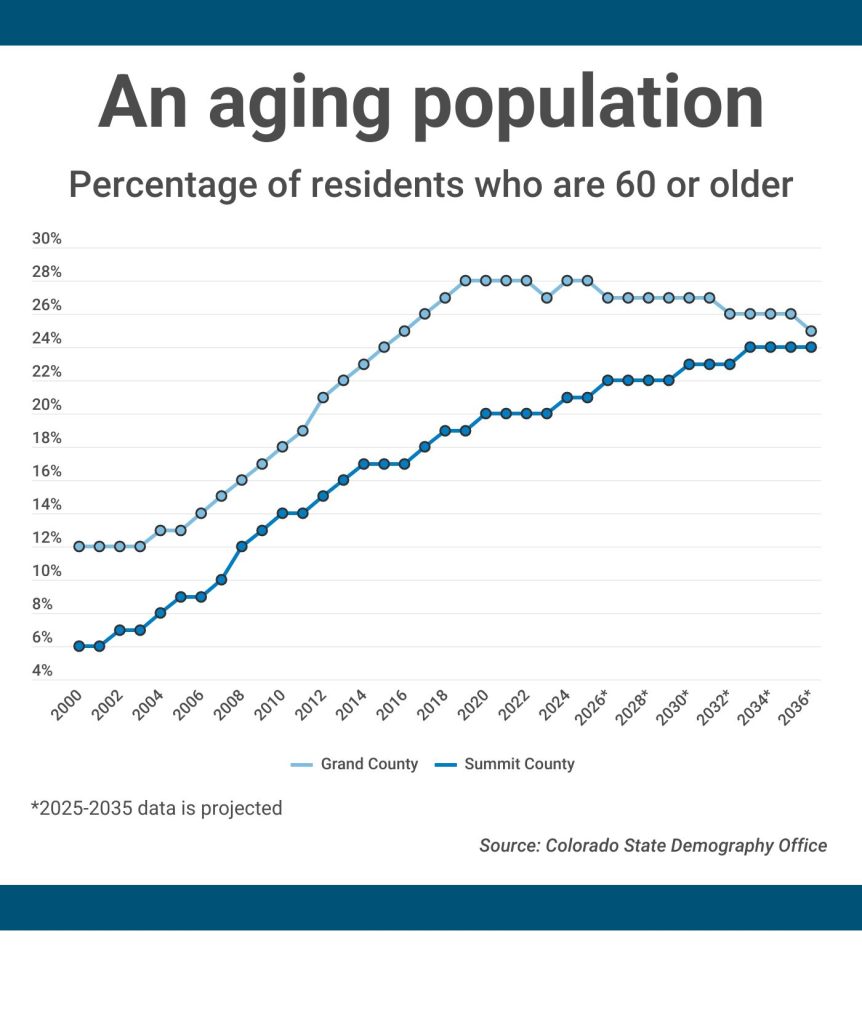
The issue of aging in place has become more prominent in Grand and Summit counties as the population of adults 60 and older has increased, in turn increasing the demand for aging-related services. In the past quarter century, the number of adults in the age group and in the group’s share of the total county population have increased significantly.
According to data from the Colorado State Demography Office, Grand and Summit’s 60-plus populations accounted for 12% and 6% of the counties’ total populations, respectively, in 2000. By 2010, those figures were 18% and 14%. The number of adults 60 or older in Grand saw a 75% increase over that time period, and Summit saw a 162% increase. The total population in both counties over the same period increased 15%. Today, Grand County’s 60-plus population accounts for 27% of the total population and Summit County’s accounts for 22%, according to demography office projections for 2026.
Projections from the demography office expect the 60-plus population in Grand to decline slightly over the next decade, bringing its share of the overall population down to 25%. In Summit County, projections expect the 60-plus population to keep growing and reach 24% of the total population by 2036.
Cleckler said the COVID-19 pandemic accelerated growth in Grand County’s population generally, including among aging adults. He said some people looked to move to rural areas because it was easier to socially isolate while others moved because their jobs had gone remote.
“They’re like, ‘Well, if I’m gonna work from home, I’m gonna live in the mountains,'” Cleckler said. “I think we started to see some of the shift in the 65 and older, too, during COVID.”
Smolkin said he saw a similar trend in Summit County, where young people moved to do remote work and realized they do not want to leave. Smolkin said he has also seen aging parents who want to be close to their children follow them to Summit.
High elevation complicates health journeys
Mountain communities have a trait that other non-metropolitan communities do not: less oxygen. Smolkin, a high-altitude specialist, said the way the body acts at high altitudes is different than at lower ones.
High altitude often causes hypoxia, a condition where body tissues have low levels of oxygen, Smolkin said. As low oxygen affects organ systems, it becomes harder for people to live at high elevations, he said.
“As we age, a lot of the mechanisms that we have in our body to compensate for that low oxygen, they start failing,” Smolkin said.
Dr. Rebecca Smiley, the chief medical officer of CommonSpirit St. Anthony Summit, said the most common medical reasons people have to leave Summit County are issues with their heart, lungs or oxygen levels. Smolkin said hypoxia in the heart and lungs can lead to pulmonary hypertension, or a type of high blood pressure that affects arteries in the lungs and the right side of the heart. It can then lead to congestive heart failure, where the heart is not strong enough to pump blood throughout the body and eventually collects in the lungs and legs.
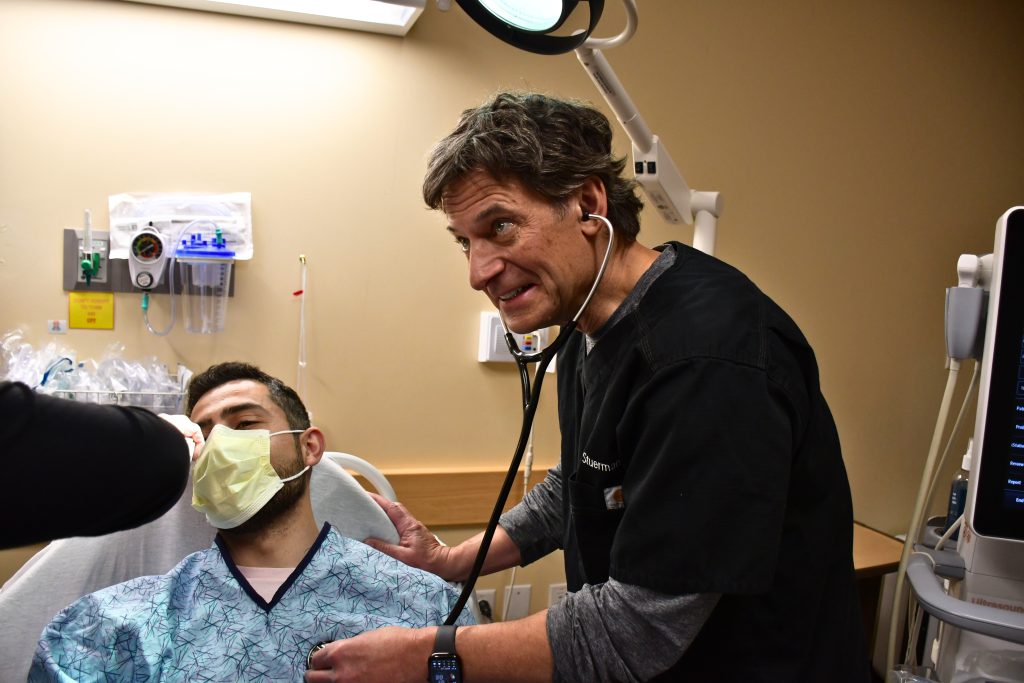
Smolkin said high altitude can exacerbate many chronic illnesses, like congestive heart failure, a point that Middle Park Health Chief Medical Officer Dr. Jason Stuerman reiterated. Stuerman added that falls often cause issues for aging adults in Grand County, explaining that residents often have to travel long distances through the spread-out county and are generally living active, mountain lifestyles.
“I saw a 92-year-old a month ago, and she told me she had just come from skiing,” Stuerman said. “I said, ‘Oh my gosh, you still ski?’ She goes, ‘Yeah, I think about five runs this morning.'”
Smiley said falls can contribute to aging adults having to leave high-elevation communities because the recovery process could decondition them. Deconditioning, she said, is what can happen when someone gets injured or sick and has less mobility for some time, meaning they are not exercising their muscles, heart or lungs.
When people become deconditioned at high elevations, Smiley said, they can lose the “state of health” that had allowed them to deal with the lack of oxygen.
“If you become deconditioned and you’re injured, it’s hard to become reconditioned. That can definitely precipitate a decline in cardiopulmonary function,” Smiley said.
Service gaps and high costs limit longevity
As part of The Longevity Project, we’re asking our readers to share their personal stories of struggles and successes related to aging in our mountain community. Go to SkyHiNews.com/submit-longevity to tell your story. Stories shared by March 16 will be published in the newspaper or online.
Aging adults in Summit and Grand counties often have to travel to Denver for treatments if their local hospital does not have the specialty care they require. The Raus have experienced that already, but if they have to stay in Denver longer for more intense treatment, not only would they need to find more appropriate housing than their friend’s condo, they might need to hire a caretaker for Charlie any time Diana cannot be with him.
Charlie said a social worker told the couple that hiring someone for 24/7 care for three to four months could cost around $80,000 out of pocket. Thanks to the Raus’ community connections and health care planning, Diana would provide care three days a week, and their insurance would cover much of the cost for hired help on the additional days. The couple has also received assistance in covering the cost of Charlie’s drugs through community support, grants, insurance and the hospital.
“There are so many unknowns, but so far we’ve been very lucky,” Diana said.
Not all aging adults are as lucky as the Raus, though. Research firm Milliman reported that a 65-year-old retiring in 2025 is projected to spend about $275,000 to $315,000 on health care expenses during retirement.
The Raus having to leave the county for Charlie’s care is not unique to mountain communities. Bob Brocker, the founder of AgeWise Colorado, said any county outside of major metropolitan areas is likely to be lacking some services, including those geared toward the aging population.
“I think, you know, the Summit and Grand areas are probably better off than some, but you still have a lot of things that are missing,” Brocker said. “People end up having to come down to Denver for some of those types of services.”
Major health care providers in Grand and Summit counties provide many specialty services often used by older adults. The realities of being rural health systems, though, mean they cannot provide all types of medical care the aging population might need.
Stuerman said Middle Park Health, like other hospitals, assesses what specialty care exists in its own and nearby communities and forms partnerships to bolster care. Cleckler added that the Grand County hospital system also tries to expand into new specialties wherever it makes sense based on the level of demand in the community.
Smiley said the Frisco hospital has added several services in recent years that are largely used by the aging population. She said a community like Summit County, though, does not have the “population base or the disease base” for every possible specialty.
Smiley pointed to hospice and palliative care, or care for people living with serious illnesses, as gaps in service in the area.
“It is not an uncommon gap in a small community or in a mountain community,” Smiley said, “but having hospice and palliative care would really allow people to have, kind of, a higher quality of life during those last, final years.”
Community building leads to support
In Summit County, Staying in Summit exists specifically to address the incomplete continuum of care, which means services are available for adults as their needs gradually increase.
Gadomski, the group’s treasurer, said the organization does not want to “sit back and wait” for local governments or others to solve the problems it sees with care for aging adults. Staying in Summit has formed a panel of organizations in the area that help people age in place, allowing the partners to better communicate and work together.
“We’re trying to work with our partners that we formed this group (with) to make it more publicly known what the needs are,” Gadomski said. “The seniors ourselves, we’re going to take on the responsibility of doing what can be done to bring the missing services here.”
The Raus said the level of connection in mountain towns has helped provide support for their situation. When they posted on Facebook about Charlie’s diagnosis, Diana said “things started exploding.” A friend created a GoFundMe for medical expenses without even telling the couple.
Whether it be people Diana has impacted through Grand Nordic or people Charlie, who retired from Grand Woodworks last year, helped with projects around their homes, Diana said people are returning the favor by supporting Charlie.
“Everybody has helped each other,” Diana said. “That’s what a community does.”
Navigating the summit of a lifetime
How mountain towns overcome the peaks and valleys of aging
- Part 1 — Staying in Grand: Experts highlight unique challenges facing older adults in mountain towns
- Part 2 — Golden wisdom: Physical activity, social engagement and finances remain key to longevity
- Part 3 — Closing service gaps: Though rural resort towns have fewer facilities, the community perseveres
- Part 4 — Community solutions: People of all ages work to improve outcomes, quality of life for seniors.Click here to learn more about the Longevity Project and get tickets to our free event at March 31 at Sun Outdoors in Granby, featuring a panel discussion with experts and an audience Q&A.
Read more at SkyHiNews.com/longevity



Support Local Journalism
Support Local Journalism
The Sky-Hi News strives to deliver powerful stories that spark emotion and focus on the place we live.
Over the past year, contributions from readers like you helped to fund some of our most important reporting, including coverage of the East Troublesome Fire.
If you value local journalism, consider making a contribution to our newsroom in support of the work we do.